
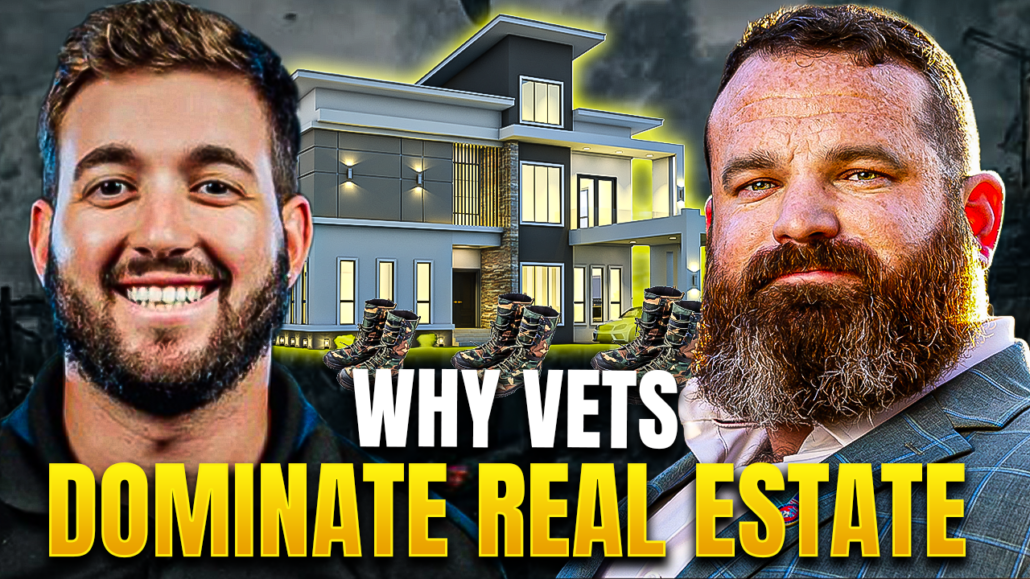
#119 How Veterans Build Wealth Through Real Estate | David Pere
How Veterans Build Wealth Through Real Estate | David Pere breaks down how David Pere went from Marine Corps recruiter working brutal hours to becoming financially free through real estate—and why he built one of the largest military investing communities online. He explains the “Rich Dad, Poor Dad” spark that led to house hacking, how veterans can use VA loan benefits to fast-track their first deal, and why purpose, identity, and community matter just as much as cash flow when transitioning to civilian life. David also shares what’s changing in his investing strategy (including development and bank-funded foreclosure auctions), how he defines success, and the simple “get in the room” mindset that helps vets—and anyone—scale faster.
===================================================
If you want to learn how to run your business in 5 hours or less…. Go to https://www.5HourBusiness.com
Subscribe to my YouTube channel:  / @tonyjavierbiz
And if you’re into flying and want to follow my Aviation journey, check out my other YouTube channel at / @tonyjaviertv
===================================================
If you want to dominate your Real Estate Market with TV commercials, go here: https://www.ClaimMyMarket.com
If you want to connect with me and my network, go to https://tonyjavier.com/connect
If you want to check out Tony’s Real Estate Resources and Vendors go to https://www.TonyJavier.com/resources
===================================================
Show Transcription:
If you end up homeless as a vet, it’s usually self-inflicted because you have more opportunities to not be homeless than others. If less than 60% of their employees are vets, I would be shocked because almost every vet I run into either works there, did work there, or knows somebody who works there. If you want to get really specific, pilots and special operations guys statistically just crush in business and investments after the military. Probably the biggest recurring theme was just how much people give in the community. And a lot of people are like, “Dude, this is the first time I felt like I could be myself since I left the military.” You don’t understand fractional lending because if the bank lends out a million dollars on a house, that is considered an asset and they can now lend.
Noah Kesslin (00:39):
What’s going on guys? Welcome back. Today we have David. David, thank you so much for taking the time coming on here today. I know you’re doing a ton of deals up in Missouri. And yeah, I kind of want to get into how you got into real estate in the first place.
David Pere (00:57):
The same way I feel like everybody does. Rich dad, poor dad. I was actually, it’s funny, I was getting, somebody was trying to get me to join Amway, and so they handed me that book. And I guess the hope is that when you read the book, by the time you’re done, you’re like, “Oh man, multi-level marketing sounds amazing.” And I read the book and was like, “Wow, real estate.” And he’s like, “No, no, no, you can do that later.” And I was like, “No, no real estate.” And anyway, so I went and bought a duplex and then I was hooked. I bought a duplex. I lived in one unit, ran the other side. That was actually in 16 days. That was 10 years ago. And I was kind of just hooked. And once I moved out, I started cash flow and I was like, “Oh, this is cool. And I don’t have to do much. I have a property manager. This is great. I should do this again.” Then the next one worked. And down the road, you realize not all real estate is always great, but there was enough at the beginning for me to go, “This works. Why would I not do more of this? ” And now it’s like, okay, yeah, sure there were some blips along the road, but still works, still does fine for me. Why would I not do more of this?
Noah Kesslin (01:56):
That’s awesome. And what were you doing before real estate investing?
David Pere (01:59):
Oh yeah. I guess that matters. I was a Marine for 13 years. And so I was seven years into the Marine Corps, eight years into the Marine Corps when I bought my first house. I was actually a recruiter for the Marine Corps here in Springfield, Missouri, which is why I bought the house here. I wasn’t from here. And on recruiting duty, working just crazy hours. Anyone who’s ever been a recruiter, especially for the Marines is like, I joke with people, I’m like, “Yeah, we probably averaged 80 hours a week.” And anyone who’s not in the military and was never a recruiter is like, “You’re full of crap.” And anyone who was a Marine recruiter is like, “That’s it. ” And I’m like, okay, see, I found an average guys because recruiting duty is a grind. And so what it is, is I had spent the first seven, eight years in the military. I deployed, I did all this cool stuff. I bought all the toys. I did all the normal military tattoos, guns, trucks, motorcycles, cars, women, alcohol. Where else can I blow my money, protein, whatever. And I’m like, “I have nothing to show for this. I’m working my butt off right now and I don’t want to do this anymore, but I can’t afford to stop.” And that’s kind of what pushed me into the looking for a way to make a little extra money and then real estate. And then yeah, five and a half years later, I was financially free and did my thing.
Noah Kesslin (03:07):
That’s awesome. What is the biggest difference? I know this is going to be a very loaded question, but what’s the biggest difference between your days in the military and now?
David Pere (03:17):
I get to do whatever I want now, and that was not the case while I was in the military. Honestly, I loved my time in the military, especially the Marine. Well, I mean, especially deployment and working up and training exercises, it was fun. And it was very fulfilling and it was a lot of really good stuff. And everyone thinks I started this to leave the military and I’m like, no, actually I would’ve stayed in the military. But the more I got promoted, the more I kind of stepped into a desk job and office job and it just wasn’t as fun anymore. And so once it kind of, I wouldn’t say stopped being fulfilling, but once it mellowed out a little bit, I was like, all right. Yeah.
Noah Kesslin (03:54):
And what does your business look like today?
David Pere (03:57):
Yeah, I mean, a huge chunk of real estate, but what we do now is we help service members and vets primarily, we’re the largest military investing community out there. So we help service members and vets essentially achieve financial freedom, right? And we have 400,000 followers across all platforms. I am sorry. I don’t know where this came from. The IDIS, the lunch. It’s about 400,000 followers across all platforms. And then we’ve got just probably next week, we’ll hit 900 in our mastermind group. And so that’s just people that are serious about achieving their goals and we’re helping them point them in the right direction for buying their first house or second house. Okay, now you want to get into wholesaling or multifamily or, “Hey, you’re transitioning out of the military. Here’s a bunch of resources to make that a smooth transition.” And so we basically just help service members, maximize their benefits, use their VA loan to house hack, get into real estate, and then scale from there. So a lot of the guys in the group are buying businesses, building businesses, all real estate. I mean, it’s kind of a hodgepodge of all things. The buzzword is financial freedom, but just financial literacy. It’s just how do I get you to never end up homeless? Because everyone talks about the homeless vets. And I’m like, it’s funny because people come to me and they’re like, “We have to do something about this problem.” And I’m like, I guess people just assume that I sit back and sit around and ruminate on how the system is screwing vets and I am not that guy. I’m like, “We did do something about the problem.” They have disability income, their own version of Section eight, the VA loan, priority for hiring, the veteran benefits, free medical, free debt, veteran benefits are insane. If you end up homeless as a vet, it’s usually self-inflicted because you have more opportunities to not be homeless than others. And so I’m like, well, let’s just make sure we don’t help. We teach people how to not self-inflict themselves in that scenario because I’m like, it’s rough because I’m like, dude, yeah, there’s a lot of homeless vets, but it’s usually a substance issue. It’s usually an identity issue, a purpose issue. So we’re like, if we can help solve the purpose, identity, substance problems with people and give them a community, I think that’s really what it boils down to. You leave the military, you lose this community in this sense of purpose and identity, and then you struggle. And if we can just help fill that gap, we keep people off the streets.
Noah Kesslin (06:02):
Yeah. Yeah. And you’re talking about this. I’m watching it in real time. One of my best friends that just got out of the military in January. So this full year has been very interesting to watch from afar. He lives in Florida. I live in Texas, so it’s been real interesting. But what would you say the hardest part about the transition? I know you talk about brotherhood. I hear most vets talk about it and just the community that you have, the support system, losing it. To challenge you, besides that, what do you think the hardest part about transitioning back into civilian lifestyle from getting out of the Marines?
David Pere (06:35):
There’s a couple … I mean, there’s a lot, honestly. One of the things that I noticed, so my last command, I was a command financial specialist. I was the guy that helped everyone do their budgets on their way out of the military. And because of these stigmas, there’s all these stigmas that the world perpetuates like, “Oh, you don’t get paid enough in the military. We don’t pay our troops enough. We need to pay them better.” And the reason for that is, in large part, if you look at a service member’s W2 stub, it’s like you made $42,000 and people are like, “That’s nothing. That’s because that’s your taxable income.” You still have housing, medical, dental, food allowance, per diem, travel, essentially all your expenses paid. Most service members are closer to the six figure mark, but because of the way people understand it, and closer to the six figure mark plus not paying taxes on half of it. So it’s like your tax bracket’s half of where it should be, they hook us up and people don’t know that. And so they think getting out of the military, they’re like, “I’m going to go get a $60,000 job. I’m going to be crushing it compared to what I was. ” And then they realize when they start getting the money and having to pay for medical and dental and this and that and the other, that they’re like, “I actually am not doing as well as I was in the service.” So I think that’s a huge shock, is realizing like, “Oh, okay, I did make more money than I thought. Now it’s a lot harder than I thought it would be because my money doesn’t go as far as it used to. ” The purpose and identity is the biggest. What happens when you join the military? You have an incredible sense of purpose to something larger than yourself. You’re serving your nation, you’re serving your calling, your country, everybody thanks you for your service every day. You get out of the military, doesn’t matter what you do, it is not the same. There’s not much out there that offers that level of fulfillment and purpose to your core identity of everybody feeling like they need to thank you for what you did. And then the identity, especially I was a Marine, so I’m a little biased, but in all the branches, your identity is like, I’m a soldier. In the Marine Corps, it’s I’m a Marine, but I’m a soldier, I’m an airman, I’m a sailor, I’m a whatever, and then you’re not. And so you spend the formidable years of your adult life, 17 or 18, most of us, to 22, which is prime prefrontal cortex development phase, having an insane purpose, getting told what to do every day and what to wear every day so you don’t have to make any of those decisions and being, I’m Dave, I’m a Marine and then 22 hits and you’re like, “My income’s not what I thought it was. I don’t know what to do tomorrow. I have to figure it out on my own. I don’t know what … I actually have to choose to wear, which sounds like a stupid thing when you think about it. I have to choose what to wear, but that’s just another piece of the puzzle that’s weird because you haven’t had to do that and you’ve wearing a uniform for four years. I don’t know who Dave is out of this uniform. I don’t really know who I am anymore. I was just a Marine.” And it’s like all of these changes in your sphere of influence, your database of who you are and people just, then you’re not in the community. And you can’t operate the same way that you did while serving, right? Because in the military, you can say, do be basically whatever the heck you want and people don’t really judge you much. Or if they do, they tell you. They’re like, “Dude, you’re an idiot. Here’s why.” And then you go in the civilian force, especially if you end up corporate, which a lot of my friends end up doing and it’s like you go from being like, “Hey, Noah, you’re an idiot. Here’s why,” to, “No, I don’t particularly love the way that I felt when you did this thing.” Fets don’t know how to communicate that way. So they struggle in a corporate environment because they’re so used to being like, “Hey, you idiot, expletive, expletive, expletive.” And then they have to learn. It’s a whole weird thing because we come from a culture where your race doesn’t matter, your gender doesn’t matter, your background doesn’t matter, your upbringing doesn’t matter. Only thing that matters is, do you do your job? Well, can you handle it when we talk shit? And if you can do those things, you fit in. And then you get out of the military and all that other stuff matters again and you’re like, “Oh my God, I don’t know what to do with myself.” So there’s a lot that ties into it. And vets just struggle because they don’t understand ahead of time that they need to find some kind of a purpose for themselves and they need to figure out that identity. And then no matter how well you think you’re set up, it’s just going to be hard to not be around the boys. Imagine you spend every day, every moment of your young adult life, essentially in locker room with a football team, being a boy with the boys, and then it’s like the next day, you don’t see them again, ever.
Noah Kesslin (10:43):
It’s
David Pere (10:43):
So weird. And then you’re like not … It would be akin to, I guess, leaving professional sports. It’s like, hang on, now what? It’s a weird thing.
Tony Javier (10:52):
You want to get motivated sellers that nobody knows about? Introducing 10X TV. If you want to create credibility in your market, find deals that nobody else knows about and crush your competition, you need to check into TV commercials. It is the new buzz in the real estate investing industry since we introduced it several years ago. I’ve been using TV commercials myself for the last 12 years and it’s absolutely crushed it. So if you want to learn how to get on TV and to do something that little to know people are doing right now, go to claimmymarket.com. Again, that’s claimmymarket.com. We usually only work with two investors per market. So if you’re interested, reach out to us and book a call to see if you can claim your market before anybody else does. Now back to the show.
Noah Kesslin (11:34):
Yeah. It’s kind of like the people that peak in high school and a lot of them are football and then when they get out of it, they’re not around that and they kind of freaks them out. It surprises me that I know a lot of ex- military and ex- Marines end up becoming cops or firefighters or something of that nature. Very much. But I’m surprised a lot more of them don’t because I feel like it’s obviously not the same, but I feel like it’s kind of that similar purpose around the brotherhood mostly. I feel like-
David Pere (12:12):
I think more do than what you see, but a lot of them do it on the federal side. And so in Springfield here, they call it the FedMed and it’s like the penitentiary for medically … I don’t know if incompetent or incapacitated is the right word, but people that need a lot of medical help in the federal judicial system and there are a ton. I mean, I wonder the stats. I would be curious, if less than 60% of their employees are vets, I would be shocked because almost every vet I run into either works there, did work there, or knows somebody who works there. And so I think a lot of people go … Because what happens is if you go state, I don’t want to misspeak here. I don’t believe your pension or your years served count even towards state law enforcement or state fire but federal fire, federal law enforcement, if you get into DEA, ICE … Boy, there’s a hot topic right now, but DEA, ICE, Marshals, even the post office, any of these federal gigs, your time served counts towards that pension. So if you did eight years in the military, you only have to do 12 in the post office to get a pension. And so a lot of guys, I think they do end up … There’s statistics for sure. There’s a very large number of guys who end up in something akin to law enforcement. It’s just like my friend Sammy, she’s been both DEA and ICE, and she was a guard. And my buddy Zach, I’m actually not going to say any more than that because his job is a little bit less public, but I have a lot of friends who get out and do … They seem to do kind of one of two things, and I guess one of three things. One is follow the same career path they were in. So if they were a pilot, they’d go fly or do something in aviation or whatever that job was, or they become a business owner, entrepreneur, investor, whatever, which I’m probably biased on that one because I probably see more of that than most people because they come, they find me they thrive in that environment or they go, yeah, Fed, law enforcement, something, because you’re right, that culture is very, very
Noah Kesslin (14:29):
Close,
David Pere (14:31):
Close enough that we’ve thought about opening our community to Fed law a few times, but we just haven’t pulled the
Noah Kesslin (14:35):
Trigger. Yeah, it definitely makes sense. I’m curious when you were starting the military millionaire, and the problem might seem pretty basic and pretty obvious, but what was the main problem that you were trying to solve when starting this business?
David Pere (14:55):
Honestly, there’s no answer to that because I didn’t know what I was starting. I just wanted to learn how to write a book, and so I started blogging, and I didn’t know what to write about. So I just was like, ” Well, I’m buying real estate. Let me just document what I’m doing. Let me learn. I’ll talk about it. “My friend Brandon was out in Hawaii at the time, and so we were talking one night and I’m like, ” Dude, you’ve written a book or two? What do I do? “He’s like, ” Just write a thousand words a day. “I was like, ” Okay, cool. What does that look like? “He’s like, ” I don’t know, dude. Start a blog. What do I write about? “I don’t know, man. Whatever you’re doing, just write. Just learn to write. Just get used to writing. I was like, ” Okay, fine “And that blew up over time for the probably the first two, three years, it was just me paying to learn to blog and learn to YouTube and just reiterating things I was learning. And then as it morphed over time and it grew, I was like, ” Oh, holy crap, we’ve got a real thing here. “And so there wasn’t any intentionality behind it at all and I kind of wish there was, but if I was to answer that question now, I mean, the root problem essentially is just, I don’t want to say financial illiteracy, but giving yourself an option. We have so many benefits. I mean, it is obscene. As much as I beat the drum of military and financial freedom, I also will not … I have no problem admitting that we have so many benefits that it would not be the end of the world if some of them got diluted a little bit. And we are taken care of. And not to say we don’t earn that, but I think vets are set up for success a ton and they don’t know, they don’t realize they kind of wait for someone to show them the way. And that’s basically what we’re trying to do. It’s like, ” You’ve got everything you need. Let’s just point you in the right direction.
Noah Kesslin (16:48):
“Yeah. Why do you think … And you said something that was pretty interesting. You said a lot of the one to three compartments and a lot of them go into entrepreneurship. I see that a lot. And it’s interesting because the whole ideology around the military is like you’re part of one thing that someone else is running, which is surprising when you say it like a lot of people that you know. And I do agree, it’s a lot of investors or just entrepreneurs in general that are from the military, but it’s interesting to go from a concept to where you’re listening to someone twenty four seven to then go to make your own decisions. Where do you think that comes from in the mindset of getting out of the military? Is it almost like trying to prove to yourself that you can do things on your own? Do you think that’s part of it? Or what do you think that has to do with it?
David Pere (17:42):
Yeah, part of it’s probably a freedom thing. You’re like, ” Man, I did what I was told and ate shit for a living for so long. Maybe I should go do my own thing. “It’s like the mechanic thing, right? You mechanic long enough in a shop and you’re like, ” Why don’t I go do this? “And I think there’s probably a huge part of it that is just a chip on the shoulder. I just don’t want to work for the man again. I’m going to go do my own thing. I also think vets are uniquely set up for that because we have a very high amount of discipline, of drive of just don’t quit. And so we make for good entrepreneurs. I don’t necessarily know what the trigger is. I think it’s kind of a chicken or the egg thing. I think the military attracts people that have that kind of drive in them and then they just keep it if you want to get really specific, pilots and special operations guys statistically just crush in business and investments after the military. And people are like, ” Well, what about special forces guys makes them or special operations guys makes them better at business? “I don’t think it’s anything. I mean, sure, there’s probably something, but I think it’s less that and more what about guys who would make incredible entrepreneurs are attracted to becoming special operations guys. And it’s the guys who are driven to just challenge the heck out of themselves on a daily and go, ” I want more. I can do better. Why have I not pushed myself here? Why am I not pushing myself there? “And then they get out of it and they’re like, ” I still need something to chase, need goals. “And then they end up crushing it in business. And so it’s kind of a chicken egg thing where most service members are hardwired to succeed no matter what. It’s why they do at a very high level in a lot of places, but a lot of them do. They’re just like, ” Man, I’m just going to stick it to the man. I’m going to go do my own thing.
Noah Kesslin (19:46):
“It definitely makes sense. Yeah. Especially, like you said, the more challenging things. I mean, there’s some things in the military that you … My buddy always said some of the jobs in there about, ” Yeah, I wouldn’t touch that with a 10 foot pole. “You know what I mean? It definitely does make sense on a very easy level, for sure. What do you think the most common misconception is about what you’re offering to vets through your military millionaire?
David Pere (20:20):
Oh, man. The more I run Facebook ads, the more I hear that we’re scammers, which is just hilarious because I offer 95% of anything you could ever want to know for free online. And I even give my book away for free, but there’s a weird misconception about how everything should just be given away all the time. It’s like an entitlement thing. And so the moment you’re like, ” Oh, we do have this one higher level mentorship, but it’s not free. “People are like, ” You’re a scam. I knew it. “And I’m like, ” Dude, we’re the biggest and most successful investing community in the world for vets. “There are people in my group who are running eight, nine figure businesses. There’s a guy in my group, I won’t mention it on the recording, but he’s the CEO for one of the largest influencers online. And that guy left an eight figure business that he’s running to go become that CEO and we’re talking about guys running nine figure organizations. I’m not the heavy hitter in the group. And so I’m like, ” Dude, where else are you going to pay a little bit of money? “I think I was just ending on the idea that essentially what other community you’re going to join where somebody with a 25, $30 million net worth is going to sit down and do a Zoom call with you or just pick your deal apart and be like, ” Hey, dude, I’ve done 300 house flips and you’re missing this. Do this. “And we just did a survey recently of the audience and probably the biggest recurring theme was just how much people give in the community. And a lot of people are like, ” Dude, this is the first time I felt like I could be myself since I left the military.
Noah Kesslin (22:04):
“That’s awesome. That’s awesome. Just a quick word from our sponsor. This episode is sponsored by 10x TV, the secret weapon behind some of the most successful real estate investors in the country. Here’s the deal. Most investors are stuck cold calling, texting, or spending hours chasing low quality leads, but the smart ones, they’re using TV commercials to flip the script. With 10x TV, motivated sellers are calling them, already warmed up, already trusting them because they’ve seen them on TV. It’s high credibility, high leverage, and way less hustle. This isn’t a theory the founder of 10xTV has been in real estate for 24 years, and TV has been his number one lead channel since starting TV about 14 years ago. Want to find out if your market’s available, go to 10xtv.co for a free marketing audit and see how TV can become your unfair advantage. Again, that’s 10xtv.co David, I’m curious to see, this year has been very interesting. I want to know a couple key strategies that you are utilizing this year that may be a little bit different from previous years.
David Pere (23:22):
Well, we’re doing our first full ground up development, so that’s one. Yeah, I’ve done a lot of weird things this year. I’ve been a bug in my lender’s ear for a long time where I say essentially like, ” Hey, if you have a deal that’s going south, I want to take it. “Because what people don’t realize is the bank, everyone thinks that the bank wants to steal your house. If you miss your payment, the bank’s going to take it. Bank doesn’t want your house. They’re not property managers, they’re not tenants or the landlords. And while everyone who’s listening to this who thinks everybody’s evil, rich people bad, probably not listening to your podcast, but those people who do hear these soundbites, they would just tell me I’m full of crap. The reality is this, even if you do think it’s a greed based thing and then therefore they want your house, you don’t understand fractional lending because if the bank lends out a million dollars on a house, that is considered an asset and they can now lend a multiple on that usually right now, probably usually seven to nine X. So let’s say you lend out a million dollars on a loan, that’s an asset. Well, now that means you have $9 million that you can legally lend out on other things to earn a return on. And if you take the house back, you don’t have that million dollar asset, you can’t lend that extra nine or whatever that multiple is. And so the bank is actually like, not only do we not want your property or to manage the deal, but we also want to be able to lend multiples on the money we lent on that house. And so anyway, so I’ve been bugging my lender forever about distressed properties and it happened this year. So about probably six months ago he calls me and anyway, took nine or three months, but basically I bought 14 houses at auction, foreclosure auction for the bank where they funded the entire note and so I haven’t, other than paying the attorney upfront, I haven’t had to use my own money for any of this yet. And then I’m going to get to renovate some of them and keep some of them and I’ll probably sell a few of them so that was cool. So buying a foreclosure deal for the bank where the bank funded it, buying or doing a ground up development. And then the other stuff, I mean, we bought an office, we bought a short-term rental, we bought an existing assisted living facility. So we’re kind of dabbling more into the large commercial and/or assisted living space as well as development. That’s awesome. That’s kind of the brunt, doing a lot more of that.
Noah Kesslin (25:55):
Awesome. I feel like success is a very interesting term. Everyone kind of thinks of it differently, strives for it differently, defines it differently. How do you define it? How do you chase for it and measure it as well as strive for it every single day?
David Pere (26:18):
For measuring, I just track my net worth the first of every month and I track my account. That’s really the only metric I care about because I’m like, dude, if my net worth is going up, great. If my net worth is going down, I can see where the problem is holistically. And I’m not a big budget spreadsheet guy, so that’s like the easy button for me. So I track that. I mean, I would just define success for me as the ability to do what I want, when I want, where I want. Today we get done with this podcast and I could go work on a project or I could go tell my COO, “Don’t talk to me. I’m done. I’m out. ” And so that I think is some level of success i called a buddy a couple weeks ago. I was like, “Dude, I want to go to Europe for New Year’s.” And he’s like, “Dope, I’m in. ” And so we bought flights and there was no PTO or asking permission or stress. It was like, “Sweet, when are you going to be there? Cool. I’ll meet you in that country on this day and then we’ll go here and then we’ll go here.” And we don’t even have the flights between countries purchased yet. We’re like, whatever, we’ll figure it out. I know I’m flying into this country, I’m flying out of that country and the interim, we’ll make it happen.
Noah Kesslin (27:35):
Whatever happens.
David Pere (27:37):
Yeah. That’s
Noah Kesslin (27:38):
Awesome. That’s awesome. If you were going to restart the actual investing company, your current company goes away, no deals. I will let you keep all the knowledge that you have over the years and I will let you have enough money to cover your minimum expenses for yourself for six months. What would you focus on first to rebuild?
David Pere (28:15):
Do I qualify for a mortgage?
Noah Kesslin (28:18):
Yep. Yep. You can qualify for a mortgage.
David Pere (28:20):
Perfect. Then I would use the VA loan, buy a fourplex, rent out as much space as humanly possible, even roommates, so I don’t have a housing expense. And then every dollar that I make off that thing, I would just roll back into a savings account to go buy the next. So better yet, if you have six months, I’d buy a fixer upper fourplex VA loan, force appreciation through a renovation, then move in, live for free. Now you got a nice updated place. It’s actually cash flowing, does well. You have a little bit of equity. If you have enough equity, you can tap that with a line of credit to leverage but I would do that to cover my expenses, and then I would go all in on driving for dollars and networking with investors and just trying to find creative deals. And so whether that’s a hundred percent seller finance deal, which is great, but a little harder to find, it could just be finding a deal and saying, “Hey, will you carry back 20% so that the bank will lend and you lend and I don’t have to put any money down and then land the deal that way.” I would do that or I would find a money partner and just be like, “Dude, I can do the work. You fund it, I’ll flip it. ” Because at the end of the day, if you’re at that early stage, house flipping and wholesaling are valuable because you can make that quick buck and then you just roll that back into properties that you can cash flow, but 300 bucks off a rental doesn’t do you a whole lot of good right off the bat, but 20, 30 grand off a flip, that will and then you can roll that into the next and the next. And then I would just keep Keep living lean.
Noah Kesslin (30:03):
So it’s interesting. I didn’t think about the military aspect. So I love how you answered that. So for someone just getting out of military, you would advise them to go use their VA loan on a duplex, triplex, quadplex, whatever they can get. You said you would have obviously that the other units would be rented, but you’re saying you would have roommates in your unit, right? I heard that right? Yeah. Okay.
David Pere (30:35):
If you’re hurting financially, rent everything. I have a buddy who, he bought a fourplex, he rented out the other three units. His unit was a three bed, two bath. And he had two roommates in it. And so he was living in one bedroom of one unit of a fourplex that was all three twos. And he was cash flowing. And it’s a $1.2 million fourplex in San Diego County. Yeah,
Noah Kesslin (31:05):
That’s crazy. And he’s
David Pere (31:06):
Cash flowing like 500, 600 bucks a month. And people are like, “Oh, that’s nothing. 500 bucks for that much money.” Yeah, you’re right. Except he would’ve been paying two or $3,000 a month to live anywhere. And so he’s saving, call it three grand, plus making 500 bucks with $3,500 swing to your monthly nut. Not to mention, on a $1.2 million fourplex, you’re paying down two or $3,000 a month in principle, if not more. And so it’s like, dude, that’s a big deal. On the low end, a $36,000 a year swing to your net worth without including appreciation or the money in your pocket or what you would’ve paid on rent.That’s pretty wild.
Noah Kesslin (31:51):
Yeah. My sister had a place in PB. It was a one bed, one bath. I think it was like 3,200 in Pacific Beach. My dad has an apartment right where the 805 and the five split. It’s like one bed, one bath, one car garage, 3,000, I think it is. I believe
David Pere (32:17):
It.
Noah Kesslin (32:17):
So that’s cashflow of 500 on a … It’s a big swing.
David Pere (32:22):
Yeah.
Noah Kesslin (32:22):
Definitely a big swing.
David Pere (32:24):
Yeah. And if you just do that and then you save what you would’ve been paying to housing, you can be investing big very fast.
Noah Kesslin (32:33):
Oh yeah.
David Pere (32:33):
Especially if you learn how to raise money and do creative financing.
Noah Kesslin (32:36):
Yeah, for sure. Who has been the biggest influence to you in this space?
David Pere (32:43):
Brandon Turner.
Noah Kesslin (32:44):
Brandon Turner.
David Pere (32:46):
Yeah, BiggerPockets. Awesome. He was the guy. Awesome. He was the Brandon who told me to start a blog.
Noah Kesslin (32:52):
That’s awesome. I want to just end here. And anyone that has just gotten out of the military or maybe they’ve been out for a while, but looking to get into real estate or just, as you put it, financial freedom. Where can they learn more about you? Where can they reach out to you if they want to learn more or talk to you or maybe join? Where can they go?
David Pere (33:23):
Yeah. Easy button is my Instagram, which is the stupid at symbol. From military two millionaire. Or if you just Google military millionaire, I’ll pop up on every platform.
Noah Kesslin (33:38):
Awesome. Awesome. Love it. Any final advice for anyone looking to grow, scale, or maybe simplify their business?
David Pere (33:46):
Dude, get in the room with people doing what you want to do. I don’t care if you have to pay a little bit of money or if you have to … And I say that I just paid $20,000 to go to a guy’s house for eight hours. I still very much believe in investing in yourself. And so get in a room with people who have already done what you want to do, somebody that you would trade spots with because they live a life that you want. And I don’t care if you have to pay or blood equity, sweat equity, whatever you got to do to get in that room. And if you get around people who are doing what you want to do, you’re going to achieve your goals. And there are going to be naysayers all along your journey. And you just need to ask yourself, are the people telling me no? Are they the people who’ve done this? It’s almost never the case. It’s usually all the naysayers, but the people who’ve never done it. And the people who’ve done it, they might steer you, “Hey, don’t buy that one. Don’t do that. Do it this way.” But they’re not going to talk down on you. They’re not going to talk you out of it. They’re going to point you the right direction. They’re going to be like, “Dude, the water’s great. Come on in. ” And so just get around people like that. There’s a million analogies for this, but probably the best is if you’re familiar with the Arnold Schwarzenegger, the documentary Pumping Iron. I’m like, “Dude, if you got into that gym at that time, you could not help but become yoked.” And if you wanted to get yoked, there’s no better place to go. And if you didn’t want to get yoked, then that’s not the room for you. Go find the room for you. But that idea, it’s like, dude, if you hung out all day every day with F1 drivers and you drove the track with them, you’re going to get better at driving. It’s the same. You want to get into real estate, but people listen to a whole bunch of people who don’t own real estate and they don’t listen to people who do. It’s like, dude, just listen to the people who’ve done what you want.
Noah Kesslin (35:40):
That’s awesome. I love it. Well, David, thank you so much for taking the time and coming on. Everyone, thank you for watching and we’ll see you next time.
David Pere (35:47):
Absolutely, Noah. Thanks for having me.

