
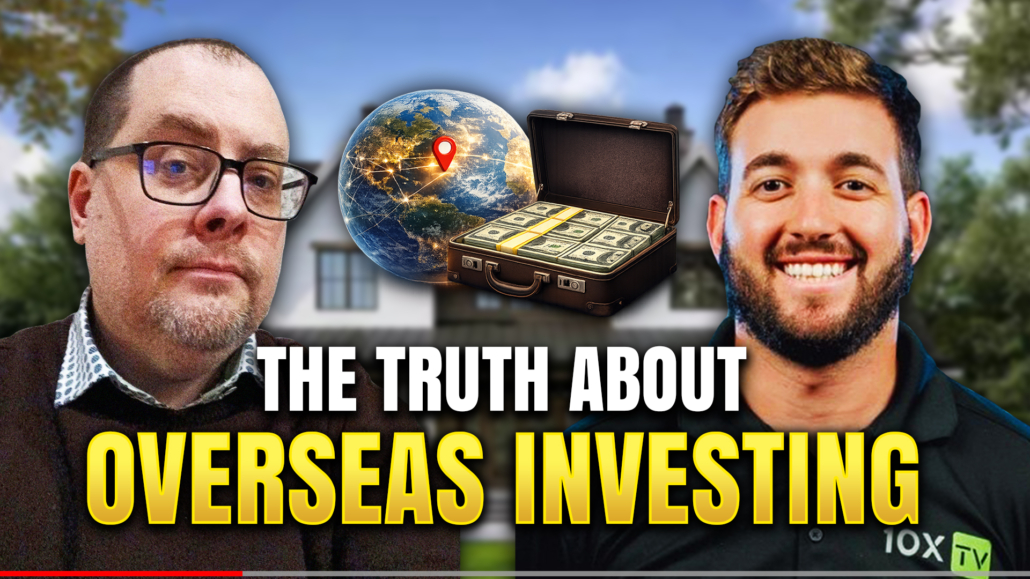
#149 Why Smart Investors Are Moving to Spain | Nathan Guilford
Why Smart Investors Are Moving to Spain features Nathan Guilford sharing how he transitioned from engineering into international real estate investing and built a business buying and renovating properties in Spain. He breaks down the massive opportunity he sees in undervalued European real estate, the differences between investing in the U.S. versus Spain, why most investors overlook overseas markets, and how long-term rentals are helping strengthen local communities. From raising capital to navigating historical properties and building systems for freedom, this episode dives deep into international investing, cash flow, and creating a lifestyle-driven business.
===================================================
If you want to learn how to run your business in 5 hours or less…. Go to https://www.5HourBusiness.com
Subscribe to my YouTube channel:  / @tonyjavierbiz
And if you’re into flying and want to follow my Aviation journey, check out my other YouTube channel at / @tonyjaviertv
===================================================
If you want to dominate your Real Estate Market with TV commercials, go here: https://www.ClaimMyMarket.com
If you want to connect with me and my network, go to https://tonyjavier.com/connect
If you want to check out Tony’s Real Estate Resources and Vendors go to https://www.TonyJavier.com/resources
===================================================
Show Transcription:
What we’re doing is we’re filling a need. There’s way more people looking for property in the rental space than there’s property available. I employ almost completely Spaniards, so that’s very important to our success. It is difficult. It’s not easy to come here. It’s not easy to learn Spanish. It’s not easy to deal with different trades and deal with the city. Once I describe to him the process of what we do, he’s like, “Wow, that’s actually…” I’m like, “Yeah, our responsibility is we want economic stability for the areas that we invest in. ” It’s a lot different than, of course, when I was 20. So now it’s more about time. So I’ve got the people and the policies and the procedures in place that buys me time back.
Tony Javier (00:43):
Welcome to the Real Estate Masters Podcast, where we bring you the top real estate investors in the country. If you also want to be in the top 1%, you are in the right place. Listening to podcasts like this is exactly what helped me to scale my real estate investing business to seven figures, flip over a thousand houses and more importantly, step out of day the operations of my business over a decade ago so I could start and grow other businesses. So get ready to learn from the best and start building a business that works for you and not the other way around. Enjoy.
Noah Kesslin (01:16):
Nathan, thank you so much for taking the time. I know you’ve been in the business for a long time and something that not a lot of people can say is that you’re investing out of the country. What is the main difference that you would say between investing in the states and investing in Spain?
Nathan Guilford (01:36):
Right. Well, there’s a lot of differences, but the main thing that we are looking at is opportunity. So there’s a lot of opportunity where they’re not as many investors in the market compared to what we have in the US. There’s not as much competition. So we’re able to get assets that are not as good for much cheaper price.
Noah Kesslin (01:59):
Interesting. And I know you’ve been investing since 1997 or 98. What were you doing before real estate and how’d you get into real estate?
Nathan Guilford (02:08):
Right. So I went to school for computer network engineering. I worked at Motorola for only about a year. I worked on a project called Iridium, which was a global constellation of communication satellites. And that was in Phoenix, Arizona. And I saw, with my engineering background, I saw a market there in the ’90s that was prime for investment. So I transitioned only one year in the engineering field and I transitioned to real estate.
Noah Kesslin (02:42):
That’s awesome. And then for the people listening, what does the business look like today?
Nathan Guilford (02:47):
Right. So personally, I own assets and investments in Arizona. That’s in our personal portfolio, but our company is Honeycutt Properties and we purchase properties in the Valencia community in Spain. So we buy assets that are non-performing or that are in need of rehab. We take single family properties and convert them to multi-units. And we’ve been doing that for a few years. Go ahead.
Noah Kesslin (03:17):
Is it hard finding crews? I’m assuming you’re doing all the property management or project management yourself. Is it hard finding crews and stuff like that in Spain?
Nathan Guilford (03:31):
So the good thing is that I live in the Valencia community. I’ve been here for a few years myself and we have a whole network of trades that we work with. Excuse me. We have architects, lawyers, attorneys, head stores, immobiliars, which are real estate agents. And we’ve got a few different crews that we work with and a few different companies that are very professional and that’s what they do full-time. And so it’s not that difficult for us to find the labor. What is the difficult thing is dealing with the cities. Sometimes you’re dealing with a city that’s 800 or a thousand years old and so you’re dealing with historical sites or buildings that are several hundred years old. That’s a lot different than Arizona. Most of the stock in Arizona is less than a hundred years old.
Noah Kesslin (04:19):
Yeah. I’m just trying to think of how much … I mean, you’d have to think everything would be different. I mean, even simple as processes. I know you spoke a little bit before starting the recording and even just the timeline of deals. I mean, it’s so much longer of duration. How are you finding the properties?
Nathan Guilford (04:40):
Well, it’s not that difficult to find them per se because we’ve built a network of agents and sellers that bring us properties. And so you don’t have the bottleneck like you do in the US where the deals aren’t there. The thing is here, there is a lot of deals. There’s just not a lot of capital to deploy into those deals. So unlike the US, which is very capital saturated, here it is not. So when you’re dealing with a project that takes a year or two to have the capital to be able to pounce on a deal. The thing is that locals really don’t have the opportunity to buy a property. When we come here from the US with our US dollar, we make so much more money than the average person in this area. I think the median income in this area is about 30 or 40,000 a year. And where I was in Phoenix, it was 80. That’s household. And so that’s a huge difference to be able to buy a property. The one that I’m working on now, the main property that I’m working on now, I paid 145,000 euros, which is somewhere in the 170s, 3000 square feet. We’re going to put between 150 and 200,000 into it and it’s going to be worth 550 in about 12 months. So those deals are here. It’s just the locals don’t have 350,000 to deploy. We don’t have hard money lending here like they do in the US. So either I have to bring my own capital, which is what I do on most of our projects, or I have to bring in either debt or equity investors into the deals. If
Tony Javier (06:15):
You want to get motivated sellers that nobody knows about, introducing 10X TV. If you want to create credibility in your market, find deals that nobody else knows about and crush your competition, you need to check into TV commercials. It is the new buzz in the real estate investing industry since we introduced it several years ago. I’ve been using TV commercials myself for the last 12 years and it’s absolutely crushed it. So if you want to learn how to get on TV and to do something that little to know people are doing right now, go to claimmymarket.com. Again, that’s claimmymarket.com. We usually only work with two investors per market. So if you’re interested, reach out to us and book a call to see if you can claim your market before anybody else does. Now back to the show.
Noah Kesslin (07:00):
In a lot of other countries, they see Americans come in and they don’t really like it. How have you seen the community react to you coming in there and actually like … I mean, obviously you’re improving their space so it’s good, but on the flip hand, I could definitely see how people would be like, who’s this guy trying to make money in our area? What have you seen there?
Nathan Guilford (07:21):
Right. So we don’t do short-term rentals. There’s a huge stigma here on short-term rentals. We provide long-term rentals. It’s different here than it is in the US. When you sign a one-year lease with a Spanish resident, they can stay up to five years as long as they don’t give notice and you can’t kick them out and you only get a percentage increase of rent every year. You can’t renegotiate the rent in one year. So what we’re doing is we’re filling a need. There’s way more people looking for property in the rental space than there’s property available. So as long as I educate the locals, that’s our first tier. I have to educate the local Spaniards and say, “Hey, look, we’re here because we’re community builders. I’m not here just to make a buck and leave.” On top of that, I’m integrated into the society here. I am a Spanish resident, not a Spanish citizen, but I do have my residence here in Spain and I own business in Spain and I employ almost completely Spaniards. So that’s very important to our success. We want to better the community and make our margin. I mean, we could come in and just totally do high-end short-term rentals and make a killing, but that’s not our goal as a business. Our goal is to come in, we can make our margins and they’re good margins and improve the properties. And then most of the time we’re keeping the properties and keeping them in our rental pool and locals are able to afford to come in and rent. So the rents here are about half of what they are in the US, but still that property that I’m going to be in for 350,000 is going to, if I have no debt servicing, is going to cash flow about 3,300 a month. It’s really good for 300,000.
Noah Kesslin (09:30):
So I mean, obviously you don’t hear many investors going to other countries and doing this. Why do you think nobody ever does it? Is it just because … I mean, it’s obviously not common. Why do you think other investors overlook this part?
Nathan Guilford (09:48):
Well, it is difficult. It’s not easy. It’s not easy to come here. It’s not easy to learn Spanish. It’s not easy to deal with different trades and deal with the city or the community or for the board for archeology. None of that is easy. And so I think that definitely puts some limits on it. And I think also I think there is a fear in the US. I mean, I’m American. I’m always going to be American. I’m never going to give up my US citizenship. I’m proud to be an American, but I think there is a stigma to come to Europe and invest for American investors or maybe a fear. And the good thing is you don’t have to be fearful and you don’t have to have that stigma. But I enjoy it because it’s given us a huge play where we’re able to fill in the gap that, I mean, it’s huge opportunities.
Noah Kesslin (10:47):
And I’m sure you can probably live in a castle there for what you’d pay for a one bedroom in LA. I’m sure it’s a huge difference.
Nathan Guilford (11:02):
Yeah. So I only live a mile and a half from the Mediterranean. I’m in the historical city center. I’m three buildings from what they call the Caye Maor, which is the main street and a palace. I’m only around the corner from a palace and a castle and my monthly payment’s 900 a month. Well, it’s an apartment that I pay. But the department that I’m in would cost, and even in Phoenix would cost 2,200 a month. I couldn’t imagine what it would cost in LA. Yeah,
Noah Kesslin (11:35):
It’s crazy. Well, what do you think the most common misconception is from the locals there about what you’re doing? And then what do you think when you tell other investors about what you’re doing there, what do you think the most common misconception is for them?
Nathan Guilford (11:53):
Right. And we kind of already touched on this. For Americans, it’s the same thing. It’s the fear or that it’s not going to get done or it’s not going to make money. I’m not really getting much pushback. I did have a friend that I was telling you that I was kind of going towards with what we were talking about a little bit before who was like, “Hey, I don’t want Americans to make money,” kind of like what you’re saying. But once I described to him the process of what we do, he’s like, “Wow, that’s actually…” I’m like, “Yeah, our responsibility is we want economic stability for the areas that we invest in. ” So the only thing that we really run into is that Airbnb stigma. And since we don’t do Airbnbs, we don’t get a lot of pushback. I do get some pushback from sometimes from American investors. Like I said, we fund most of our own deals. So even though I’ve been doing this for 20-odd years, almost 30 years, there is still this fear of uncertainty. But if Americans would come here and they would look, the community that I live in is probably only about 80% Spaniards and 20% expats. So there’s a lot of people Spain added, I think they added a few million this year from all over the world in expats. So about 50 million people in Spain. And you can’t quote me exactly on this, but I think there was like two or three million new residents this year.
Noah Kesslin (13:33):
That’s awesome.
Nathan Guilford (13:35):
So that’s really good. It’s a place where it’s going, the weather is great. The food is wonderful. The cost of living is amazing. My favorite bottle of wine here is six euros, which is about $7. And it’s something in the States that I could easily pay 30 or $40 a bottle and would have no problem. I could often go out to eat and get huge portions of food for less than $10. Yeah,
Noah Kesslin (13:59):
That’s crazy. So
Nathan Guilford (14:00):
It’s really great. The cost of living here is crazy. It’s so inexpensive. It’s like if you would’ve taken 1990 and plopped, it’s like I got plopped back into when I started investing. It’s amazing.
Noah Kesslin (14:13):
That’s awesome. In Mexico, for example, an American citizen that owns property there, the government can kind of take it whenever they please. Is that the same in Spain or okay?
Nathan Guilford (14:28):
Not at all. And I don’t buy most of the properties here. I have what’s called an SALA, which is the letters SNL, which is like an LLC. And we actually put our properties in the LLC and we get purchased … So Spain does have in certain regions, the region I’m in, Valencia, there is like a 10% closing cost in taxes and fees. So that can be a little, I forgot to say about that. But as an SALA, as a company that just buys properties, if we keep properties for 36 months or less, we only have to pay 2% if we’re doing the reform on the property and then as long as we resell, we don’t have to pay that. But their property taxes here are crazy low. One of my investment properties in the US that’s worth like 400,000 is like 3,000 or 4,000 a year. That same property here would be like 300. So I mean, you’re going to pay taxes wherever you’re at. It just in Spain, you pay your property taxes upfront. So what was your question again? I’m sorry.
Noah Kesslin (15:37):
No, you’re good. You’re good. I’m curious because obviously you’ve invested in both the states and now in Spain, which is super, super cool. What do you think separates the top operators from everyone else in your experience?
Nathan Guilford (15:54):
Here in Spain or in the US?
Noah Kesslin (15:56):
Both.
Nathan Guilford (15:57):
Well, here in Spain, it’s access to capital. That’s our main hurdle that we face. And so I only have so much capital that I can deploy. And when we have more capital and more access to capital, we’re able to do more projects and get the economy of scale. So there’s tons of … And when you’re dealing with a project that’s going to take a year to two years, you need more capital to do it. So that’s the hardest thing here. And like I said, there’s not hard money lending here. So to have that back, we are working on some different options in the US with funds and stuff. I can’t really go too much into that because of regulation issues, but there are opportunities. So the good thing is here is though once we do purchase the property and it is a performing asset, we can recapitalize and get our cash back and the interest rates here start at about 2%. So that’s really huge. And then the thing that we deal with two locals, locals I just don’t believe, and I’m not trying to be downgrading, but they just don’t have the vision. They don’t see like I see being in the US market. They don’t see what happens when you really move on a property and when you reform it because that same dilapidated property has been sitting there for maybe three generations here.
Noah Kesslin (17:15):
So
Nathan Guilford (17:15):
They’re like, whatever. But then we come in and turning it into a performing asset that’s receiving tax benefits, that has tenants, that’s giving both economic feasibility to the community plus providing housing. So it’s really wonderful to have the vision.
Noah Kesslin (17:32):
Yeah, I love that. The word success, everyone measures it differently, defines it differently, strives for it differently. How do you define the word success? How do you strive for it and how do you measure it?
Nathan Guilford (17:47):
Right. So my success now where I’m at, where I’m almost 50 is a lot different than of course when I was 20. So now it’s more about time. I’ve got the people and the policies and the procedures in place that buys me time back. So to be able to take my dog and go to the Mediterranean or be able to go … Last week was what they call Fala’s week, which is where it’s after Lent and before Easter and it’s all parties for like seven days straight and we didn’t work. We did a different party every night. We went out with friends. What’s really good here, like I was saying, there’s a group of about a hundred of us expats that are in our circle that I’m in. And so in just a few years, it’s able to make those connections and I have closer connections here in two years than I had in Arizona for 20. So that’s really success is to be able to do that, be able to go grab a beer and a hamburger with some friends anytime, day or night, or be able to go hike a mountain or go to a castle or go to a special event. And the thing in Spain is those events are going on all the time. There’s always a party going on here, so it’s really nice.
Noah Kesslin (19:07):
That’s awesome. That’s awesome.What would you say is the biggest, and we touched on it, I’m sure besides the financial piece, like the actual real estate market itself there, what’s the biggest challenge that you see in the actual market itself there besides capital?
Nathan Guilford (19:25):
For buyers, sellers, or developers?
Noah Kesslin (19:28):
For yourself.
Nathan Guilford (19:31):
I mean, really if you were to take capital out, there’s not much. Everything we’ve got under control. So I mean, you just have to be patient with the process To know that, okay, it’s August and everything’s closed in August. The Spaniards pretty much take August off or it’s Santa Samana, which is Easter week and nothing’s going to get done. I’ve been here now long enough and like I said before, I’m at a point in my career where I don’t have to say, “I got to have it right now.” No, it’s okay. It’s going to take another week. We’ve already got that panceled into our risk tolerance. So we already know when we sit down and look at a project, we figure out what holidays and what fiestas are coming up.
Noah Kesslin (20:21):
Yeah, for sure. If you were going to start from scratch today, everything goes away, the businesses go away, but you get to keep all the knowledge you’ve learned over the years. What would you focus on first to rebuild?
Nathan Guilford (20:37):
Yeah, it would be the same thing that I’m telling you. It would be raising more capital. Everything … You said the knowledge goes away or the knowledge stays?
Noah Kesslin (20:45):
You get to keep the knowledge, but everything else goes away.
Nathan Guilford (20:47):
Yeah, it would just be raising the capital. And I would’ve bought my first property, I think, quicker. I had some more opportunities and I took some time just to make sure I understood it, but there is a couple deals that I’ve seen in the last … Like I said, I’ve been here two and a half years. There’s a few deals that I’ve seen that I wish I would’ve just jumped in sooner.
Noah Kesslin (21:12):
Well, if someone listening is interested in chatting with you about this, where can they go to find you? Where can they reach out to you?
Nathan Guilford (21:21):
Right. So our website, which is honeycuttproperties.net, it’s H-O-N-E-Y-C-U-T-T properties.net. They can email me nathan@honeycutproperties.net and I can give you my personal cell too. I’ve got both a Spanish and an Arizona number, so they can call or text me on my cell, which is 480-495-8839.
Noah Kesslin (21:49):
Awesome. Awesome. Nathan, thank you so much for coming on. This has been a blast. I mean, just super interesting-
Nathan Guilford (21:55):
Yeah, no
Noah Kesslin (21:56):
Worries. But yeah, I appreciate your time, everyone. Thanks for watching and we’ll see you next time.
Nathan Guilford (22:01):
Thank you.

