
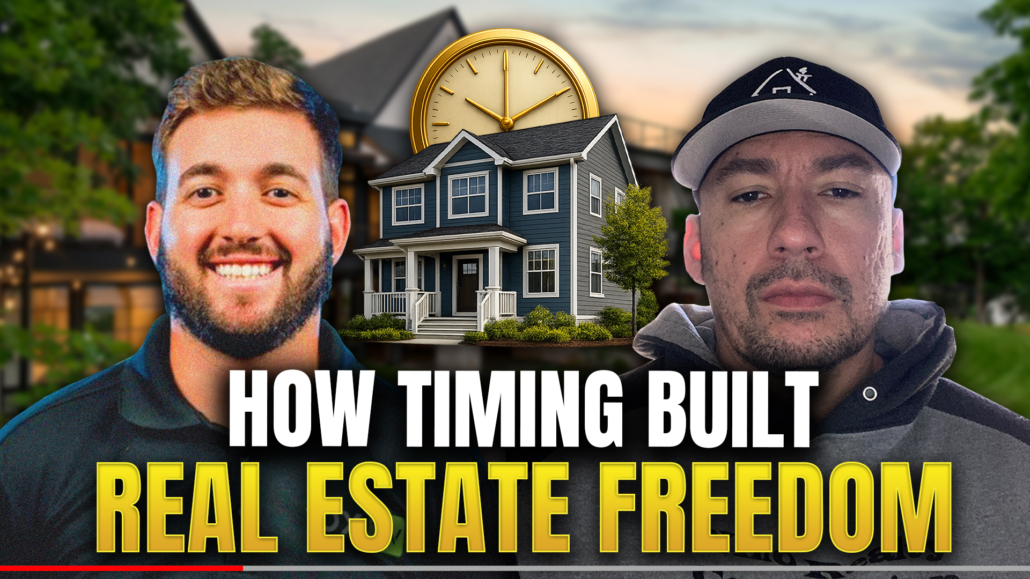
#151 How One Rental Turned Into 32 Doors | David Nino
How One Rental Turned Into 32 Doors follows David Nino as he shares how a single rental property became the foundation for a 32-door real estate portfolio. In this episode of the Real Estate Masters Podcast, David breaks down how he got started during the 2008 market crash, why distressed properties became his niche, and how long-term buy-and-hold investing helped him escape the W2 lifestyle. He also shares lessons on tenant screening, house hacking, scaling rental properties, and why freedom is the ultimate definition of success in real estate.
===================================================
If you want to learn how to run your business in 5 hours or less…. Go to https://www.5HourBusiness.com
Subscribe to my YouTube channel:  / @tonyjavierbiz
And if you’re into flying and want to follow my Aviation journey, check out my other YouTube channel at / @tonyjaviertv
===================================================
If you want to dominate your Real Estate Market with TV commercials, go here: https://www.ClaimMyMarket.com
If you want to connect with me and my network, go to https://tonyjavier.com/connect
If you want to check out Tony’s Real Estate Resources and Vendors go to https://www.TonyJavier.com/resources
===================================================
Show Transcription:
The main problem was probably just financial. I mean, the problem I was trying to solve for myself was getting something outside of my normal W2 job. I see a lot of the young investors, they’re scared to jump in. They’ll read every book, watch every podcast, but they get that paralysis analysis. I try to encourage them just to jump in even if you don’t feel like you’re ready. You’re going to learn so much on that first deal and nothing is going to teach you actually going through the experience of it. We all make mistakes every day. I would say not doing your due diligence on tenants. They say there’s no such thing as a bad tenant, but a bad landlord that didn’t do his due diligence. So you see that happen a lot. Some people might be happy going to a W2 job every day and that’s fine.That’s great. So it’s all about what your expectations are and what your goals and desires are. So like I said, I think that definition could differ from everybody, but for me it would have to be the freedom.
Tony Javier (00:51):
Welcome to the Real Estate Masters Podcast where we bring you the top real estate investors in the country. If you also want to be in the top 1%, you are in the right place. Listening to podcasts like this is exactly what helped me to scale my real estate investing business to seven figures, flip over a thousand houses and more importantly, step out of daily operations of my business over a decade ago so I could start and grow other businesses. So get ready to learn from the best and start building a business that works for you and not the other way around. Enjoy.
Noah Kesslin (01:24):
What’s going on guys? David, thank you so much for coming in and taking the time. I know you’ve been in the business for a long time, since 2008 to now. What would be the one thing you would give credit to thriving in this business since 2008?
David Nino (01:40):
I would have to say I’ve been blessed with the timing. The 2008 is when the market crashed. Everybody knows that. So there was just really good deals beginning at that time period. So I was fortunate enough to start investing around that time. And from 2008 to 2012, things were really, really cheap even I’d say all the way up until like 2018. But yeah, I mean, I was just fortunate just to get right in at the right time, start learning. And I’ve always been a hands-on mechanical type person. So I focused on distressed properties, things that need work just because you get them for a good deal and also that’s where you make your most money, I believe. I mean, someone walks into a house and it smells like cat urine. I’m smelling like dollar signs because I can vision, okay, new flooring, paint, stuff like that. That’s kind of been my niche over the years. But yeah, I’d have to credit the timing, the timing of the market. If I was to start right now, it would be more difficult. I mean, I could still do it, but the deals were just, there was so many of them. I wish I would’ve bought 10 times more if I would’ve known then what I know now. So yeah.
Noah Kesslin (02:47):
Fair enough. Fair enough. And then what drew you to the business? What got you into investing in the first place?
David Nino (02:54):
Well, I mean, I bought my first house when I was 20 and that was just for me to live in. And then I found a better house that I liked about seven, eight years later and I didn’t want to sell the other one because the market was not doing great. So I was like, “Well, let’s just try renting it out. ” And I think I was profiting maybe two or 300 a month on that house and I just went and kind of clicked for me because I was thinking, okay, if I had 10 of these, that’d be two or 3,000 a month. And I always enjoyed working on properties, the construction aspect of it, getting in contact with realtors, talking to banks, reading books, just trying to give myself as much information as possible on it. So then I saved up a down payment for the next one and then just kind of kept snowballing from there. 2011, I bought 10 units and so that was probably my biggest year. And then ever since then I was getting houses between 25 and 35,000, putting five to 7,000 in them and then they’d appraise at 100. And I just kept doing that over and over and over again as much as I could. I mean, as much money as I could spend at that time. But yeah, I mean, that’s how I got started. Once I seen that, I’m like, okay, I think I can do something here and get out of the rat race sooner than 65 years old.
Tony Javier (04:09):
Want to get motivated sellers that nobody knows about? Introducing 10X TV. If you want to create credibility in your market, find deals that nobody else knows about and crush your competition, you need to check into TV commercials. It is the new buzz in the real estate investing industry since we introduced it several years ago. I’ve been using TV commercials myself for the last 12 years and it’s absolutely crushed it. So if you want to learn how to get on TV and to do something that little to know people are doing right now, go to claimmymarket.com. Again, that’s claimmymarket.com. We usually only work with two investors per market, so if you’re interested, reach out to us and book a call to see if you can claim your market before anybody else does. Now back to the show.
Noah Kesslin (04:51):
And where are all of your investment properties?
David Nino (04:53):
Well, I’m located in the Midwest. It’s called the Quad Cities. So we’re right on the border of Iowa and Illinois, right on the Mississippi River. So I live in Illinois, but I’m two minutes from Iowa. So all my properties are on the Illinois side. I have an Airbnb on the Iowa side, which is right on the Mississippi River, which is a huge draw. It’s very peaceful out there. So one of the comments or reviews I get all the time on that property is it’s just so peaceful. You’re 30 feet from the riverbank. It’s just nice to be out there. But yeah, everything’s in Illinois except for the one Airbnbs in Iowa.
Noah Kesslin (05:29):
Awesome. Cool. And then for the people listening, what does your business look like today?
David Nino (05:34):
Well, right now I’m at about 32 doors. I focused on long-term buy and holds, so long-term rentals aside from the Airbnb. I’ve done a couple flips here and there, but right now I’m just long-term buy and hold. I self-manage my own properties so I deal with the day-to-day stuff. I just had an offer accepted last week on a fourplex, which I haven’t been buying a whole lot lately just because prices and everything’s so competitive. But this one, I got in at the right time and the price was really well for that property. So I’m closing on that one at the end of the month. But yeah, that’s where I’m at right now.
Noah Kesslin (06:21):
Awesome. Awesome. What was the main problem that you were trying to solve when getting into the business?
David Nino (06:29):
The main problem was probably just financial. I mean, the problem I was trying to solve for myself was getting something outside of my normal W2 job. So I mean, that’s kind of where it started. And like I said, I enjoyed the construction aspect of it and once I found out you could make money at it. So if you can find something you enjoy that you can make money at, then like they say, you never work a day in your life. But yeah, that was probably … Yeah, I’d say that for sure. Absolutely.
Noah Kesslin (07:06):
Yeah, for sure. What would you say is the most common misconception about what you offer?
David Nino (07:14):
Probably you get called a slumlord sometimes. So that’s probably a huge misconception. And then don’t get me wrong, there are slumlords out there. I understand that. I try really hard to give best quality of service. I see some investors that have two, three, 400 doors. I think your quality of service goes down the more doors you have. So I’m at 32 doors right now. I’m probably right at the right point. I could probably do more, but I’m able to give it good attention yesterday, the sink was leaking. I went over there this morning, tightened up the plumbing underneath and so I jump on things right away and my tenancy that they can see a difference. So like I said, for right now, I’m self-managing. If I were to get more, I might have to look into professional property management. But I mean, I recently retired from my W-2, so I have the time to do it now and it doesn’t keep me super busy, but it does give me the free time to, like I said, I can jump on something right away if I need to.
Noah Kesslin (08:26):
Yeah, for sure. How are you finding most of your properties? What are you doing to actually get the properties under contract?
David Nino (08:33):
Well, I look every day on the MLS, which the past few years has been competitive, so it’s been kind of hard for sale by owner. Last year I bought a couple duplexes off a retiring landlord for sale by owner, which was better because I didn’t have to be as competitive in my bidding. There was no one else really looking at them, so that helped. But I’m in contact with some wholesalers that will send me deals here and there, but it’s primarily been the MLS, I’d say.
Noah Kesslin (09:09):
Yeah, for sure. Well, what’s the most common mistake that you often see investors make that you think could be really easily avoided?
David Nino (09:18):
For new investors or- Or
Noah Kesslin (09:22):
Seasoned, whichever.
David Nino (09:24):
For new ones, I would say just getting started. I see a lot of the young investors, they’re scared to jump in. They’ll read every book, watch every podcast, but they get that paralysis analysis. So I try to encourage them just to jump in, even if you don’t feel like you’re ready. You’re going to learn so much on that first deal and nothing is going to teach you actually going through the experience of it.
Noah Kesslin (09:50):
Yeah, for sure.
David Nino (09:51):
So that’s for new investors. For seasoned investors, we all make mistakes every day. I would say not doing your due diligence on tenants. They say there’s no such thing as a bad tenant, but a bad landlord that didn’t do his due diligence. So you see that happen a lot. But yeah, I mean, just not taking just anybody for a tenant, get a system down, get your qualifications and just stick to it and then be that way the same way towards every tenant and just keep your rules enforceable and it’s nothing personal. It’s just how you do your process and try to keep it like that. I mean, like I said, I still make mistakes now too, but I’m a lot better than I was 20 years ago, absolutely.
Noah Kesslin (10:50):
Yeah, for sure. Well, what do you think separates the top operators from everyone else in your experience?
David Nino (10:59):
I’d say probably scaling and having systems in place. You can only do so much. I’m a one man operation. I have contractors, electricians and plumbers that I call, but if I wanted to scale up to two or 300 properties, if I could hire the right people and get that in place, I think that would help for sure. That’s definitely a huge part in it. But yeah, that sets them apart because I’ve been to some real estate meetings and I’ve met property investors that have hundreds of doors and I don’t know how they could do it. Like I said, I’m a kind of a control freak, so I need to know what’s going in, what’s coming out. I like doing the numbers. I like doing that stuff, but it’s more because I’m a control freak and I need to know what’s going on. So once I could learn to relinquish that control, maybe I’ll look into that. But for right now, what I’m doing, it works.
Noah Kesslin (11:55):
Yeah, for sure. When it comes to the word success, everyone’s got their own definition for it, their own way of striving for it, their own way of measuring it. How do you define the word success? How do you measure it and how do you strive for it every day?
David Nino (12:09):
I would have to define success. I mean, it’s probably a little different for everybody. For me, it’d be freedom. Freedom to do what you want when you want for as long as you want with who you want. If you can do that, then yeah, you’re successful. I mean, from my perspective, some people might be happy going to a W2 job every day and that’s fine. That’s great. So it’s all about what your expectations are and what your goals and desires are. So like I said, I think that definition can differ from everybody, but for me it would have to be the freedom part.
Noah Kesslin (12:48):
Yeah, for sure. What’s the biggest challenge you’re seeing in the market right now?
David Nino (12:53):
I mean, I’ve seen different challenges at different points in time. Right now, I would say probably finding good deals. Like I said, back in 2010 to 2015, it was easy, but right now I’d say finding good deals. I’ve had offers probably even last year, seven or eight properties, I was overbid and I still would lose out and it’s just I don’t see how you can make money paying what they did, but I mean, I’m not going to overbid on something that I don’t think is going to make money just to have it. So yeah, I think the challenge right now is just finding good deals. And then again, prices too. I know prices has gone up, construction materials, the trades, the electricians and plumbers, they’re charging more. So I mean, that’s another challenge right now, but I’m sure it’ll pass.
Noah Kesslin (14:01):
Yeah, for sure. If the business completely went away, all the rentals went away, but you got to keep all the knowledge that you’ve learned over the years and you were going to restart from scratch, what would you focus on first to rebuild?
David Nino (14:17):
And I have all the knowledge I have already?
Noah Kesslin (14:19):
Yep.
David Nino (14:21):
I would probably focus on financing Financing because that’s what you need. I mean, there’s other ways, but I think you need to have the money once you get that first one and then you can start multiplying from there. But yeah, I would have to have some kind of money coming in. So that’s what I would focus on and I would probably house hack. I would probably look for a fourplex, a duplex. That would be in the first property I would buy and I would live in the smallest, worst unit, fix up the other ones and then that might take a year, two years to get going and then I would do another one. So I would probably start off house hacking if I was going to start all over right now and I think it’d be easy just with the knowledge I have. I try to talk my kids into doing that. I think they’re kind of intimidated, but yeah, with the knowledge I have, absolutely. I get a roommate at least or something. Like I said, get a fourplex and you live in the smallest, cheapest apartment and then rent the other ones out and it’ll take some time, but yeah, you’ll get right back up there. Yeah,
Noah Kesslin (15:32):
For
David Nino (15:32):
Sure. Hopefully I don’t ever have to experience that, but if I do
Noah Kesslin (15:37):
100%. What drives you personally to keep innovating and pushing yourself every day?
David Nino (15:44):
Just I think not being totally content. I mean, if you’re totally satisfied and content, it’s going to pull your motivation back, but that’s a big motivation, there’s a big driver for that. So I think that’s what keeps me going. And then I don’t want to have to go back to working a nine to five job either. So I like my free time now, that drives me too. But yeah, that’d probably have to be the biggest driving factor for me, I think.
Noah Kesslin (16:21):
Yeah.
David Nino (16:22):
Absolutely.
Noah Kesslin (16:23):
Where can people learn more about you if someone’s interested?
David Nino (16:27):
I have a website with all my properties and contact information and then Instagram and Facebook. I list my rentals, my properties and stuff like that. I’ll put before and after pictures on my Instagram of properties that I buy, because usually they’re distressed so I like to see the transformation. So that would probably be the best way to reach out.
Noah Kesslin (16:48):
Awesome. Awesome. Any final advice for investors looking to grow, scale, or maybe simplify their business?
David Nino (16:55):
Just keep going, keep going. If you’re young starting out, find a mentor, finding somebody that went through the process before you. A lot of the information is out there and just buy that first property and just don’t be afraid of failure. Failure, you’re going to learn from it. The only way failure is actual failure is if you stop after that. Otherwise, it’s just a learning curve so you don’t really fail, you just got some more knowledge in my book. So yep, I’d say that.
Noah Kesslin (17:27):
Yeah, I love that. I love that. First of all, David, thank you so much for taking the time. Everyone, thanks for watching and we’ll see you next time.
David Nino (17:34):
All right. Thanks a lot.

