
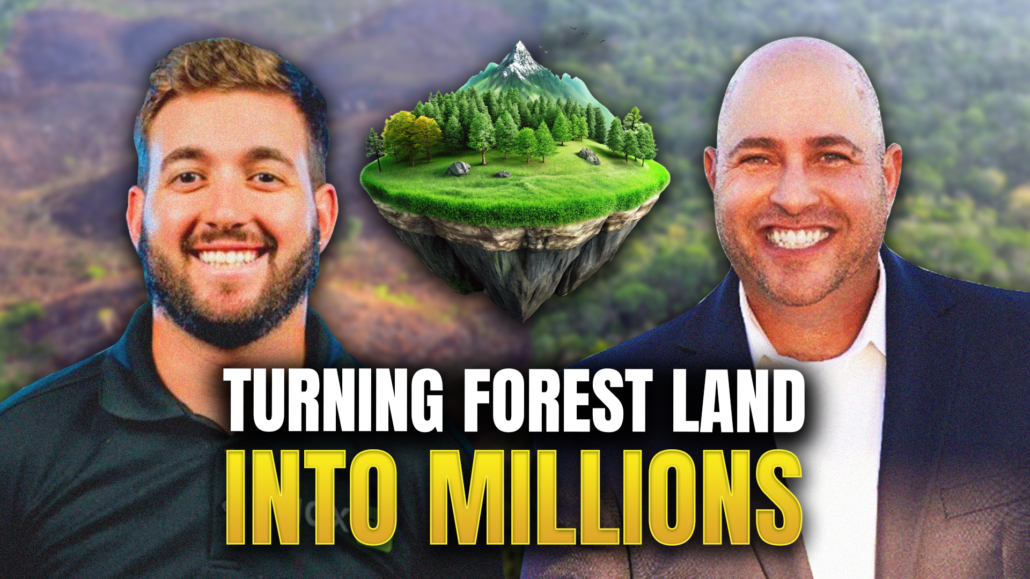
#144 Forest Land Investing Strategy | David Baker
Forest Land Investing Strategy | David Baker explores a unique approach to real estate investing that focuses on acquiring raw forest land, improving infrastructure, securing water rights, and generating long-term value for investors. In this episode, David Baker shares how he transitioned from hedge funds, home flipping, and self-storage investing into building a fund dedicated to land value creation in the Northwest United States. He explains why land and water rights are becoming increasingly valuable, how off-market relationships drive deal flow, and why a team-based approach is essential when developing raw land. David also discusses how investors can participate through a pooled evergreen fund, how AI helps with financial modeling, and why protecting land while generating strong long-term returns is central to his investment philosophy.
===================================================
If you want to learn how to run your business in 5 hours or less…. Go to https://www.5HourBusiness.com
Subscribe to my YouTube channel:  / @tonyjavierbiz
And if you’re into flying and want to follow my Aviation journey, check out my other YouTube channel at / @tonyjaviertv
===================================================
If you want to dominate your Real Estate Market with TV commercials, go here: https://www.ClaimMyMarket.com
If you want to connect with me and my network, go to https://tonyjavier.com/connect
If you want to check out Tony’s Real Estate Resources and Vendors go to https://www.TonyJavier.com/resources
===================================================
Show Transcription:
Somebody could buy a piece of land, but again, they’d have to architect and plan and coordinate everything it takes to make the land valuable. It takes time. It also takes local relationships too. Most parcels that we’re interested in purchasing are off market transactions and that requires relationships. What we’re doing is unique, buying the land, conducting the infrastructure, acquiring the water rights, et cetera, in a systematized manner. Operators are really successful, large landowners, institutions, billionaires, whomever, they have teams, which we have a team too. And I think it’s difficult without a team. It’s not a dollar figure. It’s not being on the cover of a magazine. We just want to buy and protect the land while generating an incredible target Warren Buffett-esque return. The risk in our investment thesis is not buying the land itself because one will gain-
Noah Kesslin (00:48):
What’s going on, guys? We got a special one here today. David, thank you so much for taking the time. I want to start with kind of taking a step backwards and just seeing how you got into real estate in the first place.
David Baker (00:59):
Noah, thank you for having me. Originally, I got into real estate doing residential home flipping as many people have done, and that was 25 years ago or so. And then eventually moved into self-storage and bought distressed self-storage facilities. We buy facilities that were bad locations, poor condition, low occupancy. The keys were on the floor. Garbage was stacked 10 feet high in 200 units. And then eventually moved to urban raw land for preliminary development, if you will. And then finally moved into what we’re doing at Land Value Alpha, which is forest land and conducting infrastructure water rights and holding the land for duration. So it was a evolutionary process.
Noah Kesslin (01:41):
Gotcha, gotcha. And what was your life like before moving into this model?
David Baker (01:47):
Well, I was running a self-storage business and originally going way back, I was in the hedge fund business running three small cap microcap funds. And in 2019, I was living in Las Vegas with the self-storage business and I was thinking about when I was happiest, which was when I owned a ranch in Oregon. And then I decided to travel around the country in the Western United States where I really liked to find a resort town to set permanent routes. Along that path, it was a three, four-year journey until 2022 when I discovered Kalispell and I came here and I realized the beauty, the nature, the quality of life and the economic opportunity. And along that path identified a parcel of land for our family that we bought and developed with our own capital. And in that journey, in that 22, 23 period, met the seller of the land and he was and is a very large landowner. And he conducted infrastructure on property. He didn’t do any construction and he didn’t do any mining, a very low risk way to approach developing land and improving the value. And I thought it was incredible what he was doing, the cost basis he was buying the land for at that time, which was about 12, 13 years ago when he bought this major piece that I was watching him work on. He owns many others. And I thought that the return profile was incredible with a low volatility, low risk and that it’s really not something that was being done or really is being done these days except for by very large landowners, billionaires, et cetera. But there’s really nobody out there that’s created a fund or a pooled amount of capital or some way to allow individual accredited investors to participate in this concept of buying land, conducting infrastructure, creating water rights, selling the land.
Noah Kesslin (03:34):
Awesome. And just for the people listening, just kind of explain the business model itself and what exactly your business looks like right now today.
David Baker (03:42):
So we’ve created a fund. The fund is an evergreen fund, very much a hedge fund-esque format, which has existed for 40 or 50 years. Venture capitalists are just starting to figure that out, but Wall Street’s been doing it for 40, 50 years. So we created that structure, an evergreen fund. It’s a pooled amount of capital and then each member owns their pro rata share in all of the properties. And it’s much more efficient than some of these apartment syndicators where they’re doing apartment one, fund one, all the way to apartment 16, fund 16, because the operating costs are higher for them. They’re higher for the investors. It’s very inefficient. This is one fund investors come in, they’re committed for 10 years. We are selling the land in year eight so they can have their capital back in year 10 and they own a pro rata share of every piece of property that we buy. And the model is really just having the opportunity to participate in a diversified portfolio where we’re conducting the infrastructure. From an operational standpoint, we have project managers, we have marketing people, we have analysts and all sorts of other specialists, advisors, hydrologists, geologists, water lawyers, et cetera, et cetera. So it’s a whole team. It takes a village to make this work, but the operational model is a team from different disciplines so that we don’t miss anything.
Tony Javier (05:02):
Want to get motivated sellers that nobody knows about? Introducing 10X TV. If you want to create credibility in your market, find deals that nobody else knows about and crush your competition, you need to check into TV commercials. It is the new buzz in the real estate investing industry since we introduced it several years ago. I’ve been using TV commercials myself for the last 12 years and it’s absolutely crushed it. So if you want to learn how to get on TV and to do something that little to know people are doing right now, go to claimmymarket.com. Again, that’s claimmymarket.com. We usually only work with two investors per market. So if you’re interested, reach out to us and book a call to see if you can claim your market before anybody else does. Now back to the show.
Noah Kesslin (05:44):
Awesome. Well, when it comes to starting this business, was there any major problem that you saw or anything that really prompted you to start this business? I mean, what was the piece that you saw that kind of light bulb went off?
David Baker (06:01):
Well, I think there’s a couple things. One, that there’s a major land grab now in northwest Montana, in Montana and Northwest like Idaho, Eastern Washington, et cetera. And this land grab is because there’s less and less land available and everybody needs water and land is what provides water. And the economic opportunity was just so incredible to buy at a low cost basis. The other thing that I thought was incredible and still is incredible, which is why we’re doing this is you can take a piece of raw forest land where nobody attributes or very few attribute much value to it at all. And by doing the research, demographics, understanding population trends, understanding water rights, et cetera, you can do things on the land to create incredible value in a relatively short amount of time. So for us, relatively short of time might be two years, three years, five years, because again, as we discussed Noah before this podcast, there’s seasonality and you can only work on the land when there’s not too much snow. But again, I was really prompted by the fact that no one was doing this. The cost basis is quite low, volatility is low, risk is low and you could take something that most people would think is not worth much and create tremendous value.
Noah Kesslin (07:12):
Why do you think so man investors overlook this model?
David Baker (07:16):
That’s a fabulous question. It’s funny. Sometimes the things in life to all of us are right in front of us and we don’t see it. I certainly didn’t see it myself until I started traveling in 2019 all over the Western United States and I think most people miss it because they don’t have an opportunity to actually see it. So if somebody were to take you, for example, Noah and take you up here to Northwest Montana and you are driving over properties and they show you, “Oh, this landowner owns this and this is what he did to it and this foundation owns that and this is why she or they did that to it and this is what they started with and now look what they have. And these are the market prices now for that same land that they bought for literally 20 times less 20 years ago That’s really, I think how it hits home is people having an opportunity to come up here. And I would certainly invite anybody that sees this podcast that wants to check out what we’re doing and what’s happening in the Northwest, would invite them to come up here. We’d happy to give them a tour that they won’t forget.
Noah Kesslin (08:17):
That’s awesome. What do you think the most common misconception is about what you’re offering and what you’re doing?
David Baker (08:24):
I think the most common misconception is that there’s no way for them to participate in it. So if the average person looks at a piece of forest land, let’s say 15 miles outside of Kalispell, Montana, they’re going to say, what do they do with it? How do they get started? And those are good questions to ask because it’s hard to do as an individual. The process has to be systematized. So you need, for example, a water rights lawyer, you need a road builder, you need all these things to make it possible and it’s not easily done with one person. But I think the biggest issue is just a lack of awareness that there’s even a fund like ours in the US, in the world that does this. And before we came along, it just wasn’t available. Somebody could buy a piece of land, but again, they’d have to architect and plan and coordinate everything it takes to make the land valuable. It takes time. It also takes local relationships too.
Noah Kesslin (09:20):
And when it comes to finding the actual land, any key strategies that you’re using right now to actually find the land in the first place?
David Baker (09:27):
Well, we have a land broker that we work with and he’s one of, if not the largest land broker in Montana. I met him by happenstance a year and a half ago and he took a liking to me. I took a liking to him. And so most of what we look at is actually off market. Occasionally you’ll find something on Zillow. Maybe it’s been sitting around for a while. Again, it’s in a location where people online wouldn’t necessarily understand and so you’ll see that, but it’s very rare. Most parcels that we’re interested in purchasing are off market transactions and that requires relationships.
Noah Kesslin (10:04):
I know you said there’s not a lot of competition, but is there anything that you maybe have done in the beginning or any sort of mistakes that you feel like could be easily avoided in this niche?
David Baker (10:17):
Well, I mean, let’s address first competition. So it’s not that there’s no competition for land, that would be wholly inaccurate. It’s that what we’re doing is unique, buying the land, conducting the infrastructure, acquiring the water rights, et cetera, in a systematized manner. There are plenty, and I’m certainly not embellishing, there are plenty of billionaires and large landowners that have bought up large parts of Montana, including here in the Northwest and that’s happening elsewhere too. We see Jeff Bezos and Bill Gates buying lots of agricultural land below the alluvial plane. And we see people like Michael Burry, he’s been buying, he’s interested in water as obviously it’s a huge focus for land value alpha. So Michael Burry’s decided the best way to capitalize on water and water rights is by the food supply. So he’s bought, as I understand, almond groves. And so there is plenty of demand for the land. It’s just there hasn’t been demand on a smaller scale, let’s say by 250 acres to 600 to a thousand acres versus these ultra large institutions that are buying thousands or tens of thousands or hundreds of thousands of acres at a clip. In terms of the other question you had in terms of making mistakes, I think my biggest mistake is I didn’t find this area 25 years ago
Noah Kesslin (11:50):
And the area itself is the biggest part. I mean, when it comes to building the pictures you were showing me earlier, obviously there’s a lot of land still left in Montana, but not like you said 25 years ago. What have you seen separate top operators from everyone else in your experience when it comes to land in Montana maybe specifically?
David Baker (12:20):
It’s a great question. And I think it actually is true in the Northwest is the operators are really successful, large landowners, institutions, billionaires, whomever they have teams, which we have a team too. And I think it’s difficult without a team. You need local relationships and you have to have a team of people. It might sound silly, you need to burn a burn pile. You better know how to do it so you don’t light yourself on fire and maybe you want to hire someone to do it. You need to know who to call. You need to know who’s going to be the best people for rock demolition blasting through a canyon to build a road. You also have to be aware of budgets. What does something really cost? What should it cost? And so you do need an extensive team.
Noah Kesslin (13:06):
You said something earlier that intrigued me. You mentioned living in Vegas, having a company that seems to have been doing well, but unhappy. And you think back to when you were happiest being out in nature. When it comes to the word success, everyone’s got their own definition for it. Everyone’s got their own way of chasing it. How do you measure success? How do you define the word success? And then how do you chase for it every single day?
David Baker (13:36):
Well, I define success by accomplishing my own personal goal. So my personal goal is to acquire as much land for the fund, which obviously is our investors as possible because we’re taking an impact investing approach. So we’re not buying land and creating subdivisions and just scarring the land here, there, and everywhere. We are providing a target very high rate of return with very low volatility and leaving most of the land intact. As an example, the 150 acre parcel that we purchased for our family, we’re using two, three acres at the most plus road. So maybe we call it four or five acres and the other 145 acres is left and will always be left completely untouched. Same approach with forest land in general and believe it or not, that can facilitate the highest return on investment from doing that and also help with water in a variety of ways. So that’s one way define success. How do we get there? We just continue a very disciplined, systematized approach and that’s really what it is for me. It’s not a dollar figure. It’s not being on the cover of a magazine. We just want to buy and protect the land while generating an incredible target Warren Buffet-esque return.
Noah Kesslin (15:10):
Awesome. When it comes to struggles in real estate right now and single family, there’s a lot in this area, are you seeing a lot of change in real estate right now in your specific niche?
David Baker (15:26):
Well, we’re seeing a lot of change in Kalispell and the Flathead Valley. The Flathead Valley basically goes from Glacier National Park down to Polson, which is 30 or 40 miles of land and then a 35 mile long lake called Flathead Lake, 35 miles long, 13, 15 miles wide. And that whole call it 75 mile long valley is experiencing a ton of change. For example, Costco here in Kalispell just put in their second Costco. I understand it’s the second largest in the United States because it’s growing so fast. Kalispell was ranked, I believe the number one micro city in the United States for growth in 2025. A lot of large companies are coming here specifically. I mean, Amazon has at least one facilitation warehouse here. I don’t know why the other companies are coming other than the same reasons that you or me or a doctor would come because it’s beautiful and it’s nature and it’s peaceful and it’s really like no other place. There’s tons and tons of lakes, mountains, et cetera. And it’s been happening for quite a long time. So there’s a company named Discovery Land Groups. People can look them up. They just are building, I believe, either the 38th or 39th resort about seven miles south where we bought our property about 2,300 feet below us along the lake and that’s a huge 1,700 acre resort. They also are co-owners of the Yellowstone Club in Big Sky. I think people in society in the United States are really more and more appreciating beauty, nature, some space, not fighting to find parking.
Noah Kesslin (17:16):
Yeah. Yeah. I live in rural Texas, so I definitely can agree with you there and appreciate the non-city-esque of it for sure. When it comes to today’s age of AI and all the stuff that’s coming out, is there a way to utilize that to help you guys in this? Are you guys utilizing AI in what you guys are doing now?
David Baker (17:44):
We use AI extensively for financial modeling, that’s really how we use AI. We could spend 40 hours, 50 hours, not in one day or one week, obviously, but we could spend that over weeks and weeks modeling just one piece of property. The risk in our investment thesis is not buying the land itself because one will gain passive appreciation. What we’re doing with infrastructure and water rights is active appreciation. So the risk in our investment thesis, believe it or not, is over-investing in the land. So a real world example would be we’ve been looking at a couple hundred acre parcel of land about 30 minutes outside of Kalispell above a lake and power where the utility is, is about three and a half miles away. So between trenching and HDPE conduit, running the wire, the meter bases, the panels and all that, that’s probably a million dollars. So for that particular parcel of land, that would be significantly overinvesting. You’d still get your money out of it in 10 years with a handsome profit, but you would be significantly reducing your return profile. So in that case, what you want to do is you want to put in a remote power system, which will cost you about 100K or 80K depending upon the size and you don’t want to install it in year one of buying the property. You want to wait until year eight when we’re ready to market the property and then sell the property with the remote power system. That way you have no drag on your IRR and you have brand new equipment for the purchaser. So you have to think about things like that and that’s where AI based financial modeling comes into play.
Noah Kesslin (19:28):
When it comes to the perfect avatar, if someone’s listening to this and would be your ideal investor, what would that person look like and what would they be looking to get out of it?
David Baker (19:42):
Sure. I don’t think that we have a prototypical investor in terms of a demographic profile. They just need to be an accredited investor and they need to understand that they’re committing their capital for 10 years, though we’re selling the properties in eight, beginning marketing them at that time and they need to have an interest in hard assets in land, in water, and not something intangible like a stock or bond, for example. And I think they need to appreciate that this is something that has low volatility. It doesn’t move around every day and it moves in spurts, if you will. So there’ve been a lot of events here that have driven Northwest Montana land. For example, COVID was one of them. Another one is just the growth rate here, et cetera. They just need to have an understanding of what they’re investing in. I think that’s really important.
Noah Kesslin (20:42):
Yeah, for sure, for sure. If you were going to start from scratch today, you keep all the knowledge that you’ve built and learned over the years, but the business goes away entirely, what would you do first? What would you focus on first to rebuild?
David Baker (20:59):
Well, that’s an interesting question. Well, I don’t think the business is going to go away for a very long time, but I suppose I would work for some of these institutions or billionaires on their projects doing the same thing because I really enjoy it. I originally come from the hedge fund business 30 years ago and it’s definitely gotten old driving a desk and I like being out there on a UTV, hiking the land, figuring out what to do, participating or managing the heavy equipment operation. And I like watching something onsite being created from nothing to something. Imagine just looking up at a forest and three days later there’s a road going in and three months later there’s power going in and you’re really creating something. And again, the concept of protecting most of the land is very attractive to me. I want to protect this planet and this is a small way of doing it because again, no matter which project it is, we have very little impact. For example, if you buy an 800 acre parcel of land, it might have an RV park that takes up the five or 10 acre footprint and the other 790 acres is literally untouched, but it still creates tremendous value for the investors and a return profile that’s difficult to achieve in today’s world.
Noah Kesslin (22:16):
Yeah, I love it. I love it. Where can people reach out to you? Where can people connect with you if someone’s listening and does want to invest, where can they reach out to you?
David Baker (22:27):
So the best way is just to email me invest@landvaluealpha.com. So it’s I- N-V-E-S-T, invest@landvaluealpha.com and I’ll respond promptly.
Noah Kesslin (22:39):
Awesome. Awesome. David, I appreciate your time and I appreciate you coming on. Any final advice or any final something you would say to someone listening that might make them want to invest?
David Baker (22:56):
I would say they should start reading about land and water just in general and understanding what’s happening in the West and Northwest with land and water. They can also subscribe to our newsletter. It’s a monthly newsletter. It’s not a solicitation. It’s educational and they can just come to landvaluealpha.com and on our homepage, they can just click newsletter and subscribe and start reading about it and getting themselves educated.
Noah Kesslin (23:20):
Awesome. Awesome. David, thank you so much for the time. Everyone, thanks for watching and we’ll see you next time.
David Baker (23:25):
Thank you, Noah. Thank you for having me.

