
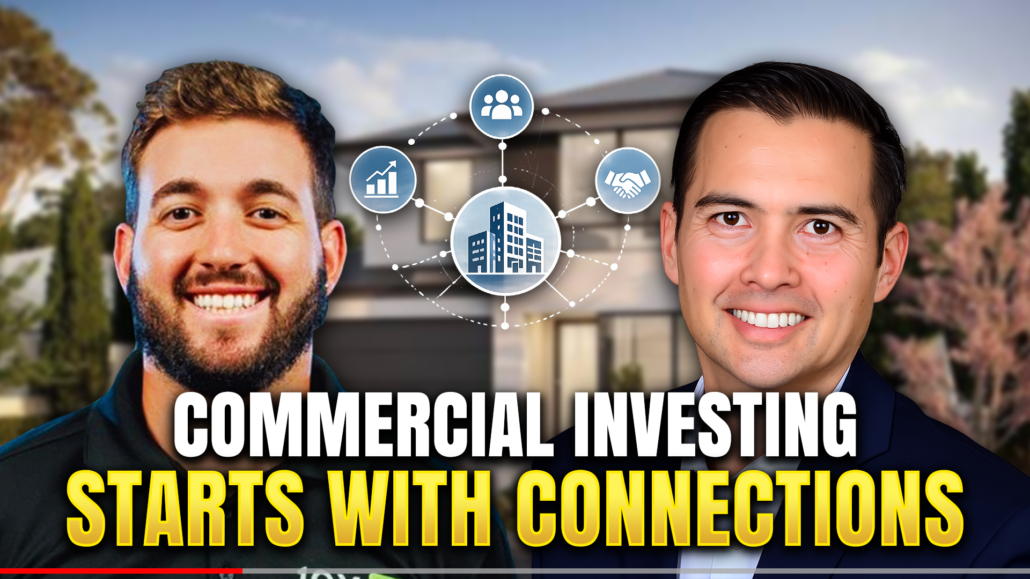
#167 Why Smart Investors Are Buying Now | Brian Sutton
Why Smart Investors Are Buying Now | Brian Sutton dives into why today’s market may offer some of the best real estate opportunities in years. In this episode of the Real Estate Masters Podcast, Brian Sutton shares his perspective on commercial real estate, distressed assets, market cycles, and why experienced investors are positioning themselves while others remain on the sidelines. He also discusses capital raising, evaluating deals, avoiding costly mistakes, and the mindset required to build long-term wealth in uncertain markets.
===================================================
If you want to learn how to run your business in 5 hours or less…. Go to https://www.5HourBusiness.com
Subscribe to my YouTube channel:  / @tonyjavierbiz
And if you’re into flying and want to follow my Aviation journey, check out my other YouTube channel at / @tonyjaviertv
===================================================
If you want to dominate your Real Estate Market with TV commercials, go here: https://www.ClaimMyMarket.com
If you want to connect with me and my network, go to https://tonyjavier.com/connect
If you want to check out Tony’s Real Estate Resources and Vendors go to https://www.TonyJavier.com/resources
===================================================
Show Transcription:
Real estate has a very low barrier to entry. Anybody can go out and not anybody, but you know what I’m saying? A lot of people can go out and buy a single family, rent it, manage it themselves. So the barrier to entry is pretty low. But what’s super interesting though is that right now what we’re finding in this iteration of our market cycle is that a lot of the deals are getting traded directly with the banks. A lot of companies have over-leveraged these assets. They’ve took out short-term debt, they’ve took out too much debt, and then they’ve overpaid. So that’s really what’s happened in the cracks and that’s where you really get yourself into trouble. And that’s no different, I think, whether you’re buying commercial or you’re buying residential. It’s really the principles in that are all the same. What’s great about real estate, what’s great about, I guess, doing business this way is that everybody can win. It can be a win-win for all parties.
Tony Javier (00:51):
Welcome to the Real Estate Masters Podcast where we bring you the top real estate investors in the country. If you also want to be in the top 1%, you are in the right place. Listening to podcasts like this is exactly what helped me to scale my real estate investing business to seven figures, flip over a thousand houses, and more importantly, step out of daily operations of my business over a decade ago so I could start and grow other businesses. So get ready to learn from the best and start building a business that works for you and not the other way around. Enjoy.
Noah kesslin (01:24):
What’s going on guys? Brian, thank you so much for coming on and taking the time. I know you’ve been in this space for over 10 years. If there was one thing that you could attribute and a credit to your success in real estate over the past 10 plus years, what would that one thing be?
Brian Sutton (01:43):
Man, Noah, you’re just hitting it right out of the gates here, right? Just get right to it. Hey, just first off, super glad to be here and privileged to be on the podcast. And it’s a super good question. I think that most of us, we’ve had a lot of successes with our company, Two Waters Capital, over the last 10 years. We’ve been blessed enough to have owned and managed over 5,000 units. We’ve done over a half a billion dollars in transactions. And so a lot of success, but I believe that we learn most in our setbacks and the roadblocks and the bumps in the road. And it’s a super interesting time in real estate right now because I think we’re going through this massive course correction. And so I think people are feeling a lot of pain. And I think through pain, we get growth. And so I’d have to just say that yeah, through the struggles over the years, just in the course of living, right? I mean, I’m almost been 50 years on this earth right now. So coming up, not quite, but coming up. So you go through a lot of struggles. And I think it’s when you come out of those struggles, you hopefully learn from those and become better and stronger.
Noah kesslin (02:59):
I love that. I love that. What drew you specifically to real estate?
Brian Sutton (03:04):
Yeah. So my evolution story was I was basically kind of born into it a little bit. My dad had rental properties. I used to help him out in high school, everything from he was cheap, so cheap child labor. I’d be the ones turning the apartments and watching them lease the apartments and purchase them to repositioning the whole thing. So I got the bug early on and when I was 22, bought my first rental property and rented out the rooms to friends and then just got the bug and itch from there. So been doing it over 25 years. And then 10 years ago, got a chance to partner up with my operational partner who’s been doing it for 50 years. So he’s actually forgotten probably more about real estate than I’ve learned over the 25 years. But he and I partnered up about 10 years ago to form Two Waters Capital.
Noah kesslin (04:00):
That’s awesome. That’s awesome. And just for the people listening, what does your business look like today?
Brian Sutton (04:07):
Yeah. So interestingly enough, our business is pretty exciting at this point. We took a, like I said, over the course of 10 years, we’ve owned and managed, bought, sold in and around 5,000 units. Over the last three years, we’ve actually been sitting on our hands and sitting on the sidelines. Hadn’t bought a property. We’ve just been kind of net sellers. There’s been a huge transition. If most of your audience, I believe, is obviously real estate driven. So they understand what’s been going on in the commercial real estate space. I would assume that obviously once interest rates were rapidly increased by the Fed several years ago, we basically have had a constricting of the capital supply and in turn, cap rates and also values of commercial real estate has really plummeted over the last couple of years. So really exciting time in the company right now because we’re actively have a fund to go out and buy these distressed assets. And we’ve got two already in our fund and are looking to add a third one. So super excited for our investors because they’re getting access to kind of these distressed deals, which we haven’t seen in probably since 2008 really. Want
Tony Javier (05:20):
To get motivated sellers that nobody knows about? Introducing 10X TV. If you want to create credibility in your market, find deals that nobody else knows about and crush your competition, you need to check into TV commercials. It is the new buzz in the real estate investing industry since we introduced it several years ago. I’ve been using TV commercials myself for the last 12 years and it’s absolutely crushed it. So if you want to learn how to get on TV and to do something that little to no people are doing right now, go to claimmymarket.com. Again, that’s claimmymarket.com. We usually only work with two investors per market. So if you’re interested, reach out to us and book a call to see if you can claim your market before anybody else does. Now back to the show.
Noah kesslin (06:02):
What was the main problem that you were trying to solve when starting this new venture 10 years ago? Obviously you’ve been in the business for a long time. What was that main reason for the transition and the partnership?
Brian Sutton (06:15):
Well, so it was a natural progression. I think I started out in single family homes and then did some 1031 exchanges and leveled up into multiplexes, so duplexes, fourplexes. And then when I wanted to enter the multifamily space, the larger apartment complexes, I just thought that it would be advantageous to partner up with somebody who’d been managing those for decades. So he’s really been kind of a mentor and not only a partner, but a mentor as well. So he really was my kind of key into learning the space. I knew a lot about real estate, but it’s a whole different world when you get into the large commercial, more institutional type assets. There’s a bigger learning curve. There’s a different network. And so it’s almost like separate investing. Even though it’s investing in real estate, it’s almost separate. So he was really instrumental into my growth and to water’s growth into that space. So that was really the precipice for that move and that change.
Noah kesslin (07:20):
Yeah, 100%. 100%. Why do you think so many investors overlook the commercial space from the single family space? And I feel like eventually a lot of them get there, but what do you think that is?
Brian Sutton (07:37):
Interesting question. So for me, I got tired of managing everything myself. And I think when you are on a smaller scale, you start to realize, I think we all get into real estate for control, financial freedom. It’s a way that you can. Real estate has a very low barrier to entry. Anybody can go out and, not anybody, but you know what I’m saying? A lot of people can go
Noah kesslin (08:06):
Out and
Brian Sutton (08:06):
Buy a single family, rent it, manage it themselves. So the barrier to entry is pretty low. Once you start doing it, if you like it a lot like I did, then you start scaling up and then you start realizing, man, I’m just creating myself a second job. And that’s really what it was for me was you’re just working twenty four seven. And at a point you’re like, okay, I have to scale this to a point where now it becomes economically feasible to hire other people to manage these assets for me. And I can concentrate more on getting quality assets, repositioning, being more strategic in the business. And so I think that to your point, I think that it’s a bigger jump and it’s a bigger leap than I think people know. But it’s not that it can’t be done. I think you just have to be very, very motivated to want to do it. And I think at certain points, if you have a larger single family portfolio, you may feel some of that burnout and want to move to larger assets to maybe change your workload so you’re not so hands-on in the management and you’re more strategic. Does that make sense?
Noah kesslin (09:25):
Yeah, for sure. 100%. Well, on the flip side, what do you think the most common misconception is about people that maybe haven’t switched from residential to commercial that you were surprised about when you flipped over to the other side?
Brian Sutton (09:44):
Well, scaling’s easier. So it’s almost counterintuitive. You think that if you’re buying on a smaller scale, you can buy a lot of small things. Well, you can only get to a certain growth when you’re in residential. A lot of it is tied to your own balance sheet. A lot of it is tied to your own capital. And so when you move into the commercial space, this is what the secrets of all the Blackstones and all these big private REITs are. They’re leveraging billions of dollars to buy huge multi-unit assets across multi different markets. And so the surprising part I think is learning that once you move into that, it’s actually easier to scale than you would think. So I think that’s what most people miss.
Noah kesslin (10:44):
It does make sense though. One thing that I feel like is always a little different from residential to commercial is how you’re finding the deals. What are some main strategies that you’re using to actually acquire and find the right properties to buy?
Brian Sutton (11:01):
Yeah. Well, it’s similar in the sense where there is a broker and things are marketed. Now it’s a trillion dollar industry. The commercial real estate is a trillion dollar industry, but it’s very funny how small it is when you start, because there’s only so many companies and so many players in the space. And so the brokerage firms are, there’s a lot less than residential. So you have to network withThose smaller brokerages because they control most of the assets and are trading most of the assets. But what’s super interesting though, is that right now, what we’re finding in this iteration of our market cycle is that a lot of the deals are getting traded directly with the banks. So companies like ours are just being fortunate enough that we’ve done pretty well in the past. And so we have. Our latest deal that we’re closing on next week is we’ve negotiated everything through the bank. The bank actually came to us and said, “Hey, we have a distressed property. These guys, this operator wants out. They had a bridge loan that’s due. We know we can’t sell this without taking a small loss. Would you be willing to take this over and help guide this thing to safety hopefully a couple years down the road?” So you start to get into that market as well where you’re starting to negotiate directly with banks. And that’s where I think that’s the really fun part. I mean, brokers are great. We have great broker relationships as well, but when you start negotiating with the biggest partner in the capital stack, which is the debt and the
Noah kesslin (12:51):
Right
Brian Sutton (12:52):
It starts to become a little bit more interesting and kind of fun.
Noah kesslin (12:55):
Yeah, that’s awesome. What mistakes do you often see investors make in the commercial space that might be different from the residential space, but that you still feel like could be really easily avoided?
Brian Sutton (13:14):
So I think mistakes are pretty common in both. Real estate in general is pretty simple. It’s about buying the right assets at the right time. And you can’t always do market timing. You can’t always time the market. But if you don’t time the market correct, the biggest issue is leverage. And you can over leverage yourself in a single family home. You can buy too much house. People do this all the time. You start making more money like, “Hey man, I went from doing real well. I climbing the corporate ladder and now I’m making X so I can buy a nice bigger house with a pool and whatever else.” You over leverage yourself. And the same thing can happen in commercial real estate. And it’s really what’s happened in this bubble is that a lot of companies have over-leveraged these assets. They’ve took out short-term debt, they’ve took out too much debt, and then they’ve overpaid. So that’s really what’s happened in the cracks, and that’s where you really get yourself into trouble. And that’s no different, I think, whether you’re buying commercial or you’re buying residential. It’s really the principles in that are all the same.
Noah kesslin (14:23):
Yeah, 100%. 100%. The word success really intrigues me. I feel like everyone kind of measures it differently. Everyone defines it differently, and they strive for it differently. How do you measure the word success? How do you define the word success? And how do you strive for it every single day?
Brian Sutton (14:46):
Excellent questions, man. You’re a hard hitter, dude. I love this interview, man. For me personally, success is how many people you can help, how much impact you can have. Because at the end of the day, it’s not about the number of units you have and the amount of real estate you own, even the amount of money you have. It’s really about what was your impact on the world? How do you give back? And how do you make the world a better place for other people, for your family? Somebody said this to me and I’m going to steal it from them, but it’s really great. And a lot of people will say that it’s just business. It’s just business. It’s not personal. And for me, and I think for anybody that I like to do business with now, and I think I’ve gotten to. What’s great about where we’re at right now is that I get to do business with people we love and people we connect with. You don’t have to do business with A-holes anymore. When you’re starting out, it’s kind of like, “Hey, I’ll just…” You start to kind of bend a little bit. And for me, business is personal. I mean, we have investors, we have family, friends that invest with us. So this is personal to me. And I think that’s how business should be run. It should be run with a personal connection. It should be run not with just like, “Hey, this is a transaction so I can burn you. Somebody’s getting screwed kind of thing, zero sum game.” What’s great about real estate, what’s great about, I guess, doing business this way is that everybody can win. It can be a win-win for all parties.
Noah kesslin (16:41):
100%. If you were going to start from scratch today, I’m curious to know your answer on this. The business goes away. I’ll let you keep all the knowledge that you’ve learned over the years. I’m going to ask a two-part question. One, would you go back to residential to start, or would you just go straight to commercial? And two, what would you focus on first to rebuild what you have now?
Brian Sutton (17:08):
I would go straight to commercial, skip all that other stuff. This is obviously, like you said, with the caveat that I know what I know now. Go straight to commercial. And then the most important thing that you can concentrate on is your connections with people and your relationships with people. So those are more valuable than the assets you’ll acquire and the money that you’ll make. The real wealth is built through your connection with others. And so that’s why I would suggest if you’re starting out, it’s about connecting. It’s about attracting the right people into your atmosphere, connecting with the right people. And then focus. I say commercial because you focus on bigger. Again, I think it gets back to our initial conversation about scale. It’s like it becomes almost counterintuitive. You’re like, “Man, when I stepped up a level, it’s going to be harder to scale this, but then it becomes almost easier.” So that’s what I would say to myself and to anybody else starting.
Noah kesslin (18:25):
I love it, I love it. I’m sure you’ve been a really big influence to other people in the space. I’m sure you’ve been a mentor to other people in the space. Who’s been the biggest mentor and the biggest influence on you in the space in the past 25 plus years?
Brian Sutton (18:40):
Well, I mentioned two of them. So my dad was my first one. I was just blessed to be born kind of brainwashed into real estate. So he was really instrumental in me just getting me kind of hooked on the business. I love it. And what I loved about it too was we were always trying to improve and create clean, safe housing for individuals and families. And I love that connection. So he really was instrumental in me getting me started. And then my partner, Joe, which I have now at Two Large Capital, and our sister company is property management company, he was really instrumental in my growth too, because he kind of opened up this whole secondary world of like, wow, this is the way commercial works and this is how we can help people on a larger and a grander scale. And so both of those people in my life have been huge, huge influences. The other one I’d have to say is my wife. I can’t get that one. So she was my best decision though. So if I had to make another decision again, it would be marrying her. That is, I think, one of the most underrated things. And I think one of the biggest. I have two boys too, and they’re teenagers now. So I’m trying to slowly drip that in their brain. I was like, look, no matter what you pick for your career, whether you’re going to do what dad does in real estate or not, the most important thing you do is picking your partner in life. And if God willing, you can pick the right one, attract the right one into your life. It just makes your life worth living and makes them so much more enjoyable to go on the journey.
Noah kesslin (20:27):
100%. 100%. If someone is interested in learning more about what you’re doing or just want to connect with you in any way, where can they find you? Where can they reach out to you at?
Brian Sutton (20:41):
That’s a great question. So call us or text me at 404-500-6876. That’s 404-500-6876. What I’ll do is if you text me the word deal, we’ll give you our seven point deal filter. It’s something that we just learned over the past, how to avoid get yourself into kind of bad deals. You can always email if you like to do email instead. It’s invest@twowaterscapital, hence the number two, waterscapital spelled out. We also have a podcast. So Lessons the Hard Way Podcast, like we were talking about before. We learn more in our struggles than we do in our successes. And so that’s really what the podcast is about. It’s about how do we learn from adversity? And if you get ahold of us or text us, we can always talk to you more about what our investors are really benefiting from, which is we’ve got our Fund 25, which we’ve got a couple assets, distressed assets that we bought from either out of foreclosure or on distressed loans. And our investors are being able to invest in a bucket of these distressed deals, which is not readily accessible to everybody else. So you can learn more about that as well.
Noah kesslin (22:07):
Awesome. I love it. I love it. Brian, thank you so much for coming on today. Everyone, thanks for watching and we’ll see you next time.
Brian Sutton (22:14):
Thanks, Ella. Appreciate it, man.
Noah kesslin (22:16):
Awesome.

