
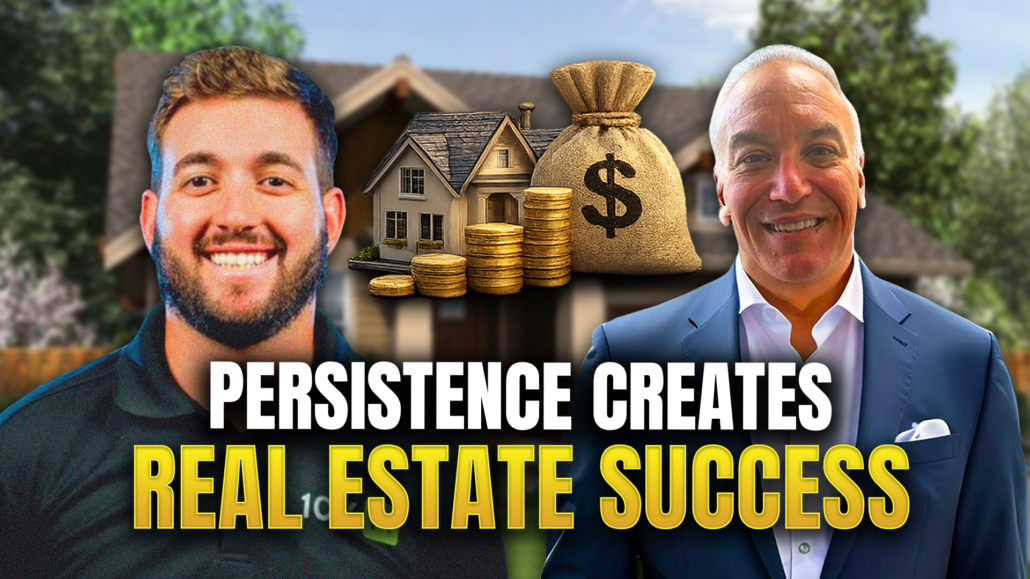
#163 The Biggest Threat to Real Estate | Rick Delgiorno
The Biggest Threat to Real Estate | Rick Delgiorno uncovers the growing challenges facing today’s real estate investors and why the industry’s future depends on credibility, advocacy, and stronger representation. In this episode of the Real Estate Masters Podcast, Rick Delgiorno explains how changing regulations, negative public perception, and the lack of a unified voice are impacting investors across the country. He also shares valuable insights on persistence, strategic planning, industry standards, and the steps every real estate professional should take to protect and grow their business.
===================================================
If you want to learn how to run your business in 5 hours or less…. Go to https://www.5HourBusiness.com
Subscribe to my YouTube channel:  / @tonyjavierbiz
And if you’re into flying and want to follow my Aviation journey, check out my other YouTube channel at / @tonyjaviertv
===================================================
If you want to dominate your Real Estate Market with TV commercials, go here: https://www.ClaimMyMarket.com
If you want to connect with me and my network, go to https://tonyjavier.com/connect
If you want to check out Tony’s Real Estate Resources and Vendors go to https://www.TonyJavier.com/resources
===================================================
Show Transcription:
If we do not have a large membership and have a voice at the table, decisions are going to be made without our input, and that’s just unacceptable. Unless you’re doing it hard and fast, this is not something that you really have your eye on the ball. It’s just not. They don’t think that. The misconception is it’s another mastermind. That’s the misconception. It is far from it. The biggest change right now is the fact that we can’t get off the credibility, it’s the Shyster concept, whatever it’s going to be, be it right or wrong, our industry’s under fire from lawmakers, from the market, and from bad PR. They overlook the fact that we need to be diligent, we need to be credible, we need to come together, and we need to really band together in order for our. Advocate for our industry.
Tony Javier (00:47):
Welcome to the Real Estate Masters Podcast, where we bring you the top real estate investors in the country. If you also want to be in the top 1%, you are in the right place. Listening to podcasts like this is exactly what helped me to scale my real estate investing business to seven figures, flip over a thousand houses, and more importantly, step out of daily operations of my business over a decade ago so I could start and grow other businesses. So get ready to learn from the best and start building a business that works for you and not the other way around. Enjoy.
Noah Kesslin (01:20):
What’s going on, guys? Rick, thank you so much for taking the time. I know you’ve been in the business for a long time, so I appreciate you coming on and sharing your expertise with us. I am curious, if you were to accredit all your success in real estate and all the time in real estate that you’ve had to one thing, what do you think that thing would be?
Rick Delgiorno (01:42):
Yeah, it’s a good question. I think the one thing would be persistence. You have to be persistent what you’re going to do. You got to make sure you’re persistent in the sale you’re going to make or the buy you’re going to make. You got to make sure you’re persistent and making sure all the details are done. So I’m going to say persistence, that’s been my success and I’ve done domestic and global sales. So whether I’m dealing with the Chinese government and purchasing office space or here in the US down in Kansas City, persistent in what it is I want to do. If I do not stay persistent, then it gets lost. And with so much going on in the world, so much distraction, you have to stay persistent. And that leads to focus, that leads to credibility, which leads to success.
Noah Kesslin (02:24):
100%. 100%. What drew you to real estate in the first place?
Rick Delgiorno (02:29):
So when I retired as a higher education administrator and part of my role was doing what they call MLUs, which is Memo’s understanding with foreign governments to do things like foreign school exchanges, student exchanges, and internships internationally and globally, excuse me, globally. And one of the things I had to do was for one of my universities was to buy office space in Japan, Rome, and Tokyo, as well as other countries, Korea and stuff like that. So me and another vice president went and started buying real, or you don’t buy. In London, you get a 99-year lease type thing, or in the UK. So we started purchasing or renting real estate. Then my son got in it and he was really successful. I started working with some local teams and then ultimately was a fractional CEO with others. So I saw that we were doing very well with them. So I started picking up my own portfolio and here I am.
Noah Kesslin (03:27):
Awesome. I love it. I love it. What was life like before investing for you?
Rick Delgiorno (03:33):
So I traveled the world. I was a vice president of engagement or international engagement for a director, worked my way up to vice president for Temple University and in Philadelphia. So I traveled the world about 160,000 air miles a year. So I had an office in Beijing, as I mentioned, Tokyo, as I mentioned, Rome, and then in Philly. So I would travel to those areas about 10 weeks a year. So it was great. And then I retired from there and I got into behavioral. I retired and realized that I was too young to retire. So I got behavioral and mental health medicine and healthcare. Made a great career and used that money to start buying and holding properties and buying, selling and flipping. I don’t do so much flipping. I have a goal. That goal is to get $24,000 a month in residual income. And so that’s what I’m working on towards. But I’ve always been goal-oriented, especially working in different parts of the world. Yo had to be goal-oriented because you’re in Turkey one day, you’re in Dubai next, and then here you are back in Philadelphia. Yeah, you have to be goal-oriented. It’ll never achieve what you need to set out for. 100%. My life before that was all about international relations.
Tony Javier (04:48):
Want to get motivated sellers that nobody knows about? Introducing 10X TV. If you want to create credibility in your market, find deals that nobody else knows about, and crutch your competition, you need to check into TV commercials. It is the new buzz in the real estate investing industry since we introduced it several years ago. I’ve been using TV commercials myself for the last 12 years and it’s absolutely crushed it. So if you want to learn how to get on TV and to do something that little to no people are doing right now, go to claimmymarket.com. Again, that’s claimmymarket.com. We usually only work with two investors per market. So if you’re interested, reach out to us and book a call to see if you can claim your market before anybody else does. Now back to the show.
Noah Kesslin (05:30):
And then for the people listening, what does your business look like today?
Rick Delgiorno (05:34):
So I have several businesses. So I’m a fractional COO for a lot of small and upcoming. So we’ll say the 127,000, 174,000 to nine million type investor, because then they’re bigger companies that take the 10 million above. I also own a behavioral health and consulting firm. And then our biggest deal now is our National Association of Real Estate Investors and Service Providers, which is really an advocacy program, a legislative voice program for investors, people like you and me who want to do this for a living. But unfortunately, there’s a lot of bad actors in our world, so we try to root them out.
Noah Kesslin (06:15):
Yeah. What was the main problem? And that’s kind of a simple one on that front, but what was the main problem that you were trying to solve when starting that business?
Rick Delgiorno (06:24):
Credibility. Unfortunately, as I mentioned a minute ago, there’s a lot of bad actors. So if we do not. The main problem is we don’t have a voice at the table legislatively. So if we do not have a voice, get a large membership and have a voice at the table, decisions are going to be made without our input. And that’s just unacceptable. Real estate, the Pennsylvania Area Real Estate Association for Realtors, National Association for Realtors, every industry has some sort of AFSCME. Every industry has some sort of association to advocate for them and to lobby for them and to give members benefits. So look, there’s a phenomenal amount of masterminds out there, family, investor fuel, Collective Genius. They’re incredibly great. This is not a competitor to that. This is the, I would say, the college team to the NFL team where if we can get people to do things right and advocate and show the world that we are taking control and policing our own industry, then we will have all the say we want and what is we want to develop for our industry. Then people like you and me can become successful and join Collective Genius, Investor Fuel, all those incredibly, incredibly great programs. This is not a mastermind. This is about solving one problem, credibility. I guess another thing is to have a voice, but in order to have voice, you have to have credibility. So we’re starting an accreditation program that will be an 18 module course. I’m working closely with some learning management systems to kind of partner up with them so we can do this in a real, real way so that when we go to Washington or you go to your local government or you go to your state government, you have credibility and they’ll take you seriously.
Noah Kesslin (08:19):
Yeah. Why do you think a lot of investors are overlooking this piece of it?
Rick Delgiorno (08:25):
Because honestly, in fairness to them, they are focused on the next deal. They need to make deals and they need to make money. This is not something, unless you’re doing it hard and fast, this is not something that you really have your eye on the ball. It’s just not. They don’t think that. I only know it because I’m a fractional CEO for a lot of organizations throughout the last 10 years. And I see the struggles. All of a sudden, Airbnbs can’t. All of a sudden investors are running into HOA issues and Airbnbs. There’s no one at the table. The whole deal with South Carolina, them cracking down wholesaling and things like that. There was nobody at the table. No one to represent our interests. So that’s why. And people just take it on the chin. And I keep saying, we don’t need to take it on the chin anymore. We need to all grow together and collaborate and get someone who knows how to work with the government and know how to hire K Street lobbyists, which is what you need to do it. You and I can’t do it individually because we’re out hustling deals, closing, going to the next one, flipping, going to the next one. Buy and holding, dealing with tenants, go on the next one. So we’re going to be the association that does that. It’s in education. It’s in medical. At the end of the day, why is there an American Medical Association? Because doctors don’t have time to go lobbying our lawmakers. So guess what? They’ll pay a fee. They pay a lot more than we charge, but they’ll pay a fee. They’ll go and they’ll get their interest represented.
Noah Kesslin (10:07):
Yeah, for sure. On the flip side, what do you think’s the most common misconception from the investor standpoint of what you’re doing?
Rick Delgiorno (10:16):
Is there value? They don’t see the value. They don’t see the trees for the forest. They don’t see the value. Well, that’s not true. People are seeing the value, especially with our ads running. They’re like, “Ooh, I never thought of that.” The misconception is it’s another mastermind. That’s the misconception. It is far from it. People don’t need another networking event. People don’t need another. I mean, we’ll have those elements certainly because 99% of the folks that are in this business just are unable to, what’s the word I’m looking for? Unable to be in a mastermind. They can’t afford it or they don’t have the time or whatever. So there will be a natural kind of come together network program. Community is
Noah Kesslin (11:00):
What I’m
Rick Delgiorno (11:00):
Trying to say. Community. But this is not another meetup. This is more of a, we come together, discuss issues, talk about advocacy, talk about accreditation, talk about credibility, and we educate people to be the best that they could be in the industry, just like every other industry has its own association.
Noah Kesslin (11:20):
I love it. I love it. On the flip side, what do you think’s the biggest change that you’re seeing in real estate right now?
Rick Delgiorno (11:31):
Well, there’s a lot of regulations coming and that’s what really prompted this from a lot of people on the board. The biggest change right now is more and more people don’t understand that real estate. Well, first of all, housing prices are starting to rise, so it’s even tougher for us to buy homes. The biggest change right now is the fact that we can’t get off the credibility. It’s the Scheister concept, whatever it’s going to be. Be it right or wrong. Our industry’s under fire from lawmakers, from the market, and from bad PR. So how many times do you go and you talk with a seller and all of a sudden they have seven postcards there? That type of thing. So it’s like, go you guys. No, it’s not. We actually solve problems. We solve people’s problems. If you look at it, 80% of the people that want to sell their house can’t do it traditionally because of time, treasure, or whatever else they have that they’re lacking. We come in to solve a problem and we make a deal. It’s no different than them selling a used car or we’re selling a rapper from a manufacturing thing. We come to solve a problem. It’s just for some reason our industry’s under fire. And that’s fine. But you know what? It’s time to bootstrap up and make sure that people understand that we’re credible, great operators. And there’s always going to be some in the industry. I mean, look at podcasts. Just look at tech. There’s a lot of bad actors in that. But at the end of the day, what sets us apart? What sets us apart is we’ll be credible, we’ll be accountable. And quite frankly, we’ll educate the ones that want to do it right. And the ones that don’t, they will get pushed out of the market.
Noah Kesslin (13:14):
100%. 100%. Well, what mistakes are you seeing investors make that you think could be really easily avoided besides the bad apples? As far as the good apples, what mistakes are you seeing them make in the market?
Rick Delgiorno (13:33):
Yeah. So a lot of the mistakes is they don’t have a system or process in place. They just kind of go off of what they read on a podcast, excuse me, on a YouTube video. They think they read a YouTube video or watch a YouTube video and then odor off the races. There’s a lot of complexity to our industry, which you well know, and a lot of people listening will also know. That complexity gets overlooked. And so that complexity causes what I would say challenges to our industry and challenges to our credibility. So as a result, those complexities will cause our industry to come under fire. So they overlook the fact that we need to be diligent, we need to be credible, we need to come together, and we need to really ban together in order for our advocate for our industry. So that’s why we started, it’s called narius.org, N-A-R-E-I-S.org. So we need to come up with national standards. We don’t have national standards. That’s where everybody’s overlooking.
Noah Kesslin (14:42):
Yeah, I love it. How do you measure success? The word success, very intriguing to me. I feel like everyone defines it differently. They measure it differently. They strive for it differently. How do you define the word success? And then how do you measure that definition of it?
Rick Delgiorno (14:59):
Well, in order to have success, you have to have goals. With goals, you have to have a plan. I’m going to put it this way. I tell my clients all the time, you have to have a strategic plan, whether you’re one person, you’re a million people or a thousand people. So plans are like a flight plan. I have a flight. I need to get from A to B. So in flight it’s I need to get from one airport to the other airport. I got to do it safely without bumping into things. Or if I run into something, excuse me, if I encounter something, I need to know how to get around it. Okay. So you have that analogy in place. So the same thing in business. I need to get from 400,000 to 4.4 million in 18 months. All right. If you don’t have a system and process in place or a flight plan, you’re going to be very unsuccessful. You’re just going to wander around. You’re just going to fly around. You may eventually get to that airport, but you might bump into a few things along the way, mountains, things like that. Or you might just land the wrong airport because you didn’t have a goal. Okay. So if your goal is just to go fly around, in this case, do business, great, that’s what you need to do. You’re not the type of person I’m going to work with. But if you say, I need to go from here to here and I need to do it in this timeframe, then we do MBAC analysis. And so that’s really what people need to remember. That’s what success is. So once you have a goal, you have expectations that once you can measure up to day to day in our industry, because you remember, in our industry, you have 52 chances to get it right. That’s it. That’s one week for the year. If you miss on. A lot of times, a lot of these places will say, “Well, let’s do a quarter check. Uh-uh, it’s too late.” Because in our industry, typically Q4 is junk because the holidays are coming. No one’s making moves. Boys. All of a sudden my dogs came down. What the heck? I don’t know. They’re never around. And so if you’re not checking each week and i.e. You have a goal, i.e. You have an action plan, then you have nothing to measure. So if you do have anything to measure, then you don’t know what success is. So success is how am I doing each week? Am I getting close to that goal? If the answer is yes, then you’re on the road to success. If the answer is no, you’re not going to be successful. But it’s better to find out in week 14 or 19 than it is when it comes to week 50. You go, “Oh my God, two more weeks in a year and I missed.” So to me, success is having a plan in place, setting metrics and achieving those metrics. That’s success. Now, success for you, Noah, is going to be different than success for me, which is going to be different than success for Tony. So we all have different success planned, but the principles are the same. I need to get from A to B, i.e. The flight plan concept. And I need to be able to, if I can get to it. And for instance, if you’re flying and you’re going from Pennsylvania to Ohio, but all of a sudden you start seeing the new Freedom Tower. Well, I’m towards New York. I better make a turn here. If not, I’m just going to keep flying around. So that’s what the weekly checks are about.
Noah Kesslin (18:16):
I love it. I love it. If you were going to start from scratch today, you get to keep all the knowledge that you’ve learned over the years, but the businesses, the money, everything goes away. What would you focus on first to rebuild what you have now?
Rick Delgiorno (18:32):
So the first thing I would focus on is my strategic plan. What am I going to do and how am I going to get there?
Noah Kesslin (18:39):
I love it. I love it. I love it. I’m sure you’ve been a very big influence to a lot of people in this space. Who’s been the biggest influencer or mentor for you in this space?
Rick Delgiorno (18:50):
Yeah. Boy, that’s a tough one. So I’ve had the honor of working with a lot of people. And then a lot of people, even at my age, take me under their wing. But I would say some of my biggest mentors, I will say I’m a big fan of Tony and Javier. I’m a big fan of Steven Trang, Tiffany High, and Eric Brewer. So I think they all have something. They’ve all seen the worst and they’ve seen the best. And so I’m all about what has worked, what hasn’t worked, and what have you done? So they’re some of my biggest inspirations. My son too. My son was very successful in this business and he went on to another business. But for me, those folks are very inspirational. When I get up in the morning, they’re the ones I check their emails quick or check their blogs quick. I think they. It’s another one, two other people that I really find fascinating. Jason Lewis is another one. I just inspired by him. We talk the same language and I don’t know, we understand each other. We’re both on the concept of you have to have the strategic plan. And then honestly, my other heroes are, and my other inspirations are just a small person who’s just going at it, doing well. I run into a lot of people who do that. So I really appreciate them doing what they do. So I’m inspired by each and every one of them. So when I go to Investor Fuel, I go Collective Genius. I don’t go to Collective Genius that much, but Investor Fuel, watching those people do like Josh Hines and Ashley Hines, watching them do what they do, that’s just phenomenal. Those people inspire me to this day.
Noah Kesslin (20:39):
I love that. I love that. Where can people learn more about you? If someone’s interested in joining or just hearing more about it, where can they go? How can they get in touch with you?
Rick Delgiorno (20:52):
Well, they are welcome to contact me through LinkedIn, but more importantly, they can go to our website. It’s www.naris. It’s N-A-R-E-I-S.org. They are welcome to look for me there. They’re welcome to contact me through LinkedIn, like I said. So my team is standing by. We are getting every day, you can always tell when we have ads go out, we get more and more inquiries. And just people are afraid to, they just don’t understand, especially in this industry, how important it is to have representation, advocacy, credibility, and accreditation. And we’re just teaching them one podcast, one telephone call, one meeting. I’m not a salesperson, to be honest with you. I’m an operations person. But we got to start in a shoestring budget because here’s the thing, at the end of the day, this isn’t for us to make money. 8% of every person of our membership fees goes to administrative services just to keep the website running and keep advocacy and things like that. The other 92% is going to go to our lobbyists, accreditation, learning management. It’s going to go to the organization. So we’re not going to get rich doing it, but we’re all going to get rich doing it because we’re all going to be protected. We’re going to be accredited, and we’re going to have a say at the table before somebody else does it. Because if somebody else does it, they’re not going to understand what we do. They don’t understand what we do. They simply don’t understand that we’re solving many people’s problems, so we’re going to make sure they know.
Noah Kesslin (22:27):
I love it. I love it. Well, Rick, thank you so much for coming on, talking to us today. Everyone, thanks for watching and we’ll see you next time.
Rick Delgiorno (22:35):
Thanks, Noah. Goodbye.

